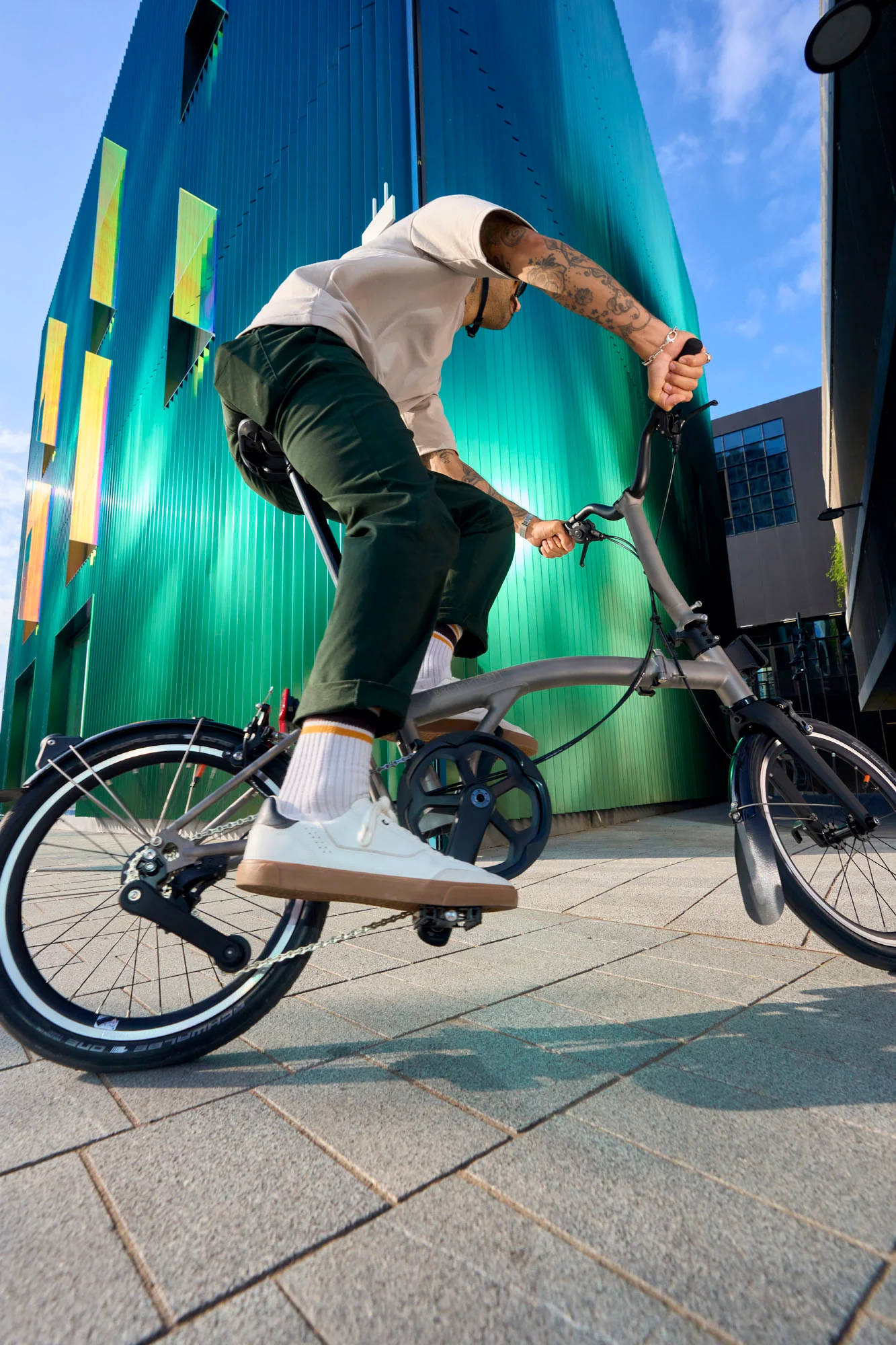
The 50-year British folding bike just took Chinese capital and Decathlon money
Brompton is a 51-year-old British folding bike. You fold it in half, carry it on the train, lean it against your desk. It costs 4-5x what a normal Chinese city bike costs. For 3 decades it was a niche London commuter product with a cult following and a waitlist.
Then the European cycling boom died. Brompton lost £2 million after tax last year. The year before, pre-tax profit was £4,602... on £122 million in revenue. Two straight years of a premium brand printing nothing.
And in June 2026, Brompton did something British premium brands almost never do. It sold ~15% of itself for £18 million to Decathlon and the Shanghai VC fund behind Pop Mart and Labubu.
Implied valuation: £120 million. For a company that just lost £2 million. The math only works if you know the China number.
Europe collapsed. China grew 32%.
Brompton's global bike sales dropped 7.5% last year. Post-tax losses doubled to £2 million. Revenue barely moved. The post-pandemic European cycling boom ended and took Brompton's margins with it.
But Brompton's China revenue grew 32% through the downturn. The brand opened 10 new stores in cities including Beijing and Shanghai in 2024, bringing total China retail to 21 direct stores across 20 cities plus 40+ dealer locations. Tmall flagship and WeChat mini-program running alongside.
China is now Brompton's fastest-growing market. The buyers: 25-40-year-old urban professionals in Shanghai, Beijing, Chengdu, and Shenzhen. A Brompton in China starts around RMB 13,000 (~$1,800) and runs up to RMB 35,000 (~$5,000) depending on spec. They're buying for social status and cycling-club membership. The bike sits in the apartment as a lifestyle object as much as a commuting tool.
BA Capital saw that 32% and wrote a check.
The partner split
Decathlon Pulse: Global sporting goods retail across 60+ countries and 1,700+ stores. "Brompton corners" inside select Decathlon stores as a soft-distribution channel. Product supply-chain engineering. Decathlon is the world's largest sporting-goods retailer with deep China manufacturing partnerships.
BA Capital: Chinese consumer investing at the highest level. Pop Mart (Labubu) and Laopu Gold (17x post-IPO). Chinese urban 25-40 consumer intelligence. Xiaohongshu, Tmall, Douyin, WeChat operating know-how. Chinese premium-lifestyle brand positioning.
Brompton split the check. Western retail scale from one partner. Chinese consumer expertise from the other.
Chinese cycling peaked. Brompton's timing is the story.
China's premium cycling boom started around mid-2022 and peaked in 2023-2024. Trek, Specialized, Cannondale, Cervelo all took market share. Premium bikes above RMB 15,000 grew 30-50% annually.
By mid-2024, the market cooled. The Xiaohongshu cycling conversation shifted from equipment reviews to lifestyle content. Premium road-bike sales flattened. Category-average prices came down.
Brompton arrived at the inflection. The brand sits in a Chinese mass-premium bracket (RMB 13,000-20,000 for most buyers) where the road-bike segment stalled but the urban-lifestyle segment kept moving. Folding bikes carry a different story than road bikes in Chinese cities. They're everyday carry. You fold it onto the metro. You ride it to brunch. That flexibility protected Brompton from the cooldown that hit pure-sport premium brands.
The "Brompton corner" is the distribution template
Brompton told Jiemian News (界面新闻): "At this stage, there is no immediate plan to sell Brompton bicycles in Decathlon stores." Instead, they're exploring premium display corners in select Decathlon stores focused on "professional urban commute scenarios."
Decathlon added: "This partnership aims to support Brompton's development plans, including continued product supply expansion and further focus on key growth markets like China and Germany."
Translation: Chinese consumers will see Brompton corners inside select Decathlon stores by late 2026 or early 2027. The bike won't sit on a shelf between Decathlon's own €300 city bikes. It'll have its own branded space with its own price bracket and its own visual language. Premium brand inside mass-retail shell.
If your brand is considering Chinese mass-retail distribution (and you should be), this is the structure. Branded corner with independent pricing. Visual separation from the host retailer's own product. Decathlon and Brompton just designed the playbook.
Your cap table is missing a Chinese name
Split your cap table between Western retail and Chinese consumer. Brompton sold 10% to Decathlon and 5% to BA Capital. The two-partner structure gives you global distribution scale from one side and Chinese consumer intelligence from the other. If you're raising to fund Chinese expansion, include at least one Chinese consumer VC on the cap table.
Chinese sell-through is the signal. Brompton grew 32% in China while losing £2 million globally. If your brand is growing in China but bleeding everywhere else, double down on China. The instinct to "fix Europe first" is how you miss the window.
Study the Brompton corner before signing a Chinese distribution deal. The branded-corner-inside-mass-retail model protects your premium story while giving Chinese consumers casual exposure at scale. A full Tmall or JD marketplace store competes on price with every parallel import and gray-market seller. A Decathlon corner competes on experience.
Take Chinese consumer VCs seriously. BA Capital's portfolio represents the sharpest read on Chinese consumer trends available through a single investor. Chinese consumer VCs now offer something Western investment banks can't match: Xiaohongshu-native market intelligence and Gen Z consumer data from inside the ecosystem.
Brompton lost £2 million after tax. BA Capital looked at the China growth curve and bought in at £120 million anyway.
If the investors behind Labubu think a 51-year-old British folding bike has a Chinese future, your brand probably does too. The question is whether you'll raise for it... or watch your competitor do it first.

