You Can Now Rent a 15,000-Yuan Brompton From a Locker in Shanghai. A Bike-Sharing App Owns It.
A Brompton folding bike in China runs from roughly 15,000 to 30,000 yuan. Most people will not spend that on a product they have never ridden.
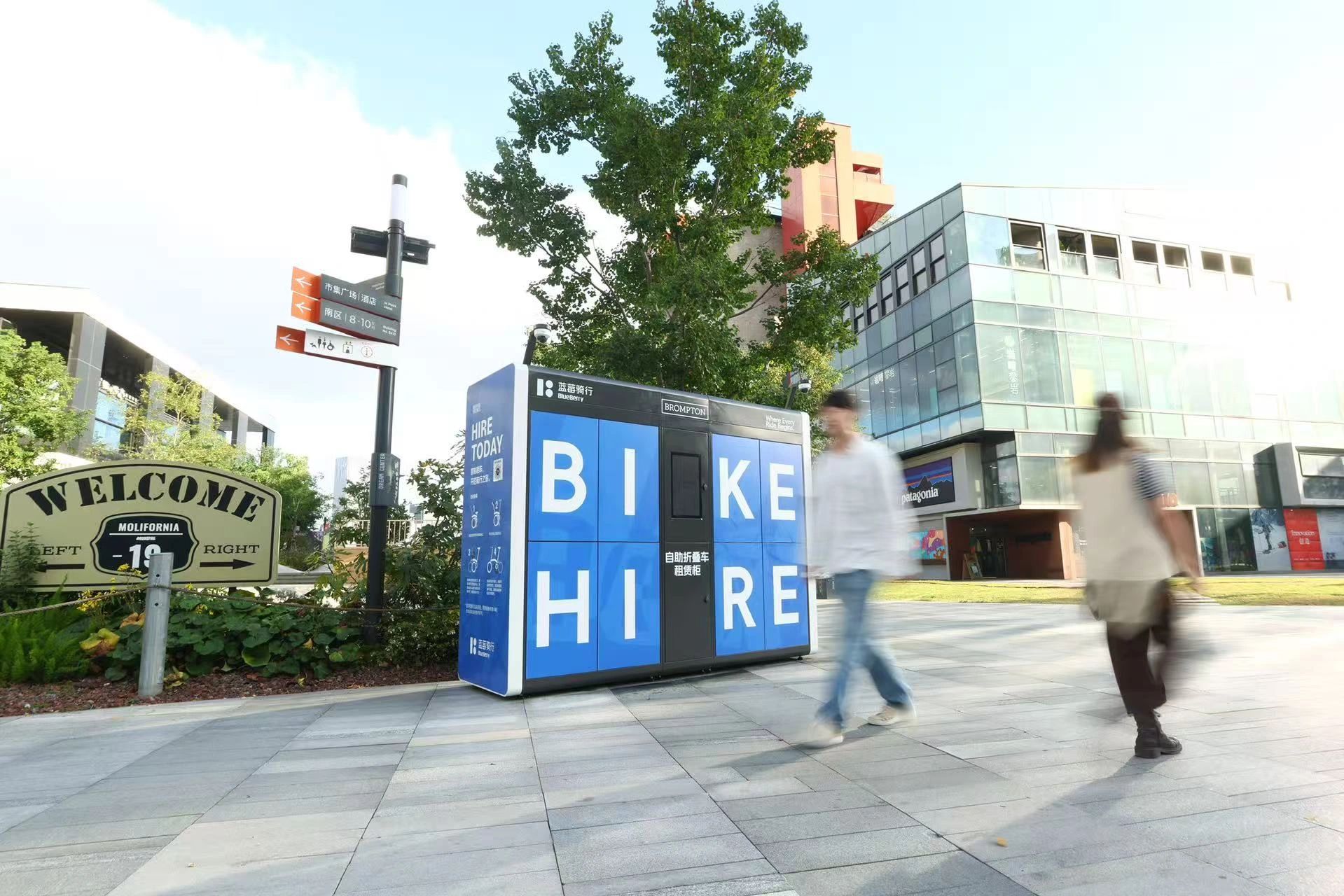
So in Shanghai you can now scan a code at a mall entrance, take a Brompton out of a locker, ride the river, and drop it at a different locker.
The lockers are Brompton-branded. They are operated by a company whose main business is 2-yuan shared bikes.
That second fact is the story.
What happened
On October 23, Blueberry Cycling (蓝莓骑行), the premium cycling platform owned by bike-sharing group Hello (哈啰), switched on Brompton Hire self-service rental lockers at Shanghai's West Bund (西岸), announced at the West Bund International Tech Consumer Carnival.
The setup:
Brompton Hire's first self-service locker project in Asia
Two locker units, at the entrances to West Bund Dream Center (梦中心) and West Bund Phoenix Nest (凤巢)
Eight bikes per unit, mostly C Line with some limited editions
Together with Blueberry's West Bund flagship, three pick-up and drop-off points
Scan to unlock, ride, return at any of the three
More than 40 riders ran the full loop at the launch, a mix of existing Brompton owners and people considering a purchase.
Worth noting that this carries Brompton's own Hire branding, which means this is sanctioned from the top rather than a dealer renting out stock it could not sell.
The model, and what it costs
Blueberry's pitch is 以租代购, yi zu dai gou, rent instead of buy. Brompton in China goes by 小布, Xiao Bu, Little Bu.
When the West Bund flagship opened in April, the published rates were 179 yuan a day for a 15,450-yuan Brompton and 319 yuan a day for a 29,995-yuan P Line, alongside a 9.9-yuan "ride a Little Bu" promotional trial. Those are April figures and may have moved, so check the current mini-programme before building anything on them.
Run the arithmetic though, because it is the most useful number in this story.
At 179 yuan against a 15,450-yuan bike, the daily rate is about 1.2% of retail. At 319 against 29,995 it is about 1.1%. Which means roughly 86 to 94 rental days to recover the retail value of the bike, before anybody pays for servicing, damage, the locker, or the floor space it sits on.
Steal that benchmark. If you are modelling a trial programme for a premium product in China, around 1% of retail per day is where an operator who has built one for real has landed.
The argument Chinese riders are having
Here is the part the glowing write-ups leave out, and it matters if you are thinking of copying this.
Chinese cycling communities are openly sceptical. The sharpest version of the objection: one day's rental on a base Brompton costs about what a Hello monthly-pass user spends to ride shared bikes for a year. On Xiaohongshu the debate is simply 花这个钱值不值, is this worth the money, and that question is the main controversy around the whole business.
Community write-ups comparing rental rates across six cities report daily rates running as high as 589 yuan for some models, which sharpens the point.
For a brand owner the question is not whether consumers think it is expensive. It is whether a trial converts or substitutes. Somebody who rents a Brompton three weekends a summer for 537 yuan may finish the season satisfied rather than inspired to spend 15,450. Nobody has published conversion data, which means the mechanism is proven and the economics are not.
Why a shared-bike company is selling 15,000-yuan bikes
The logic is straightforward once stated. Cheap shared bikes got a very large number of Chinese people riding. A fraction of those riders now want a better bike and have no idea which one. Hello already has them in an app, with a payment method saved and a habit of unlocking things with a phone.
So Hello is climbing its own category. It owns the bottom and is building the place where people sample the top.
Blueberry's West Bund flagship, opened in April at the West Bund Art Centre, reportedly runs to 500 square metres across three floors with a cycling museum, a workshop and a fitting lab, carrying Specialized, Trek and Brompton. Around the rental sit accessories, repairs, consignment, group rides and bike fitting. Expansion is planned beyond Shanghai into Hangzhou, Hong Kong, Yunnan and Guangdong.
The location choice is deliberate and worth copying. West Bund is a weekend destination with families and an 11km cyclist-friendly riverside road, and the lockers sit at mall entrances, so the bike meets the shopper on a trip they were already making.
The trade nobody is naming
For Brompton this looks like a clean win. Distribution, trial, a built-in audience of curious riders, no app to build.
Look at what moves across the table though.
Whoever runs the trial owns the first touch. The customer downloads Hello's app, pays Hello, and gets a sense of the brand through Hello's locker, Hello's servicing standard and Hello's customer support. The rental history, the repeat behaviour, the browsing before the booking, and the conversion event itself all sit with the platform.
Access is worth paying for, and this is what it costs. A brand that signs a trial partnership without negotiating for the data has handed over the most valuable output of the programme and kept the least valuable one, which is the rental margin.
The consignment business deserves a second look for the same reason. A platform building a liquid secondhand market supports residual values, which helps justify the price of a new bike. It also gives a shopper a cheaper way to own one. For a premium brand that cuts both ways and is worth having a view on before it scales.
What a brand owner should do with this
1. Price a trial at roughly 1% of retail per day, then see whether it survives contact with your margin.
Blueberry has landed at 1.1% to 1.2% of retail per day. Take your hero product, apply that, and work out how many rental days it takes to recover the unit before servicing and logistics.
If the answer is 90 days, you need to know whether your product survives 90 rentals looking like something someone would pay full price for. That answer determines whether this model works for your category at all.
2. Go after the platform that already owns the cheap end of your category.
Brompton did not partner with a luxury retailer. It partnered with the company renting out 2-yuan bikes, because that is where the volume of entry-level users sits and where the upgrade motive is strongest.
For your category, work out who owns the mass-market version of what you sell, with an app and a saved payment method: sports and fitness apps, equipment rental platforms, travel apps, gym chains. Have that conversation before you have the one with the department store.
3. Negotiate for the trial data in the first contract, not the renewal.
Specify it before you sign: rental frequency by user, repeat rate, time between first rental and purchase, and purchase conversion, delivered monthly in a usable format.
Platforms will resist this and will often concede a restricted version, because at the start of a partnership they want the brand more than they want the data clause. That leverage disappears once the lockers are installed.
4. Run it in one city and instrument conversion before anyone discusses rolling it out.
Issue every renter a time-limited credit toward purchase, coded so you can see exactly which rentals turned into sales. Set the window at 30 to 60 days and measure three things: how many renters buy, how many rent repeatedly without buying, and what the second group's total spend looks like against a purchase.
If the repeat-renters-who-never-buy group is large and profitable for the platform, you have found a substitution business wearing a trial business's clothes. Better to learn that in one city.
5. Own the condition standard in writing.
A premium product in a public locker is a brand experience you do not control. Specify in the agreement who services the bikes, to what standard, on what interval, who inspects, and at what point a unit is pulled from the pool and replaced.
A scuffed, badly adjusted example of your hero product, handed to a first-time customer at a mall entrance, is an advert you paid to run against yourself.