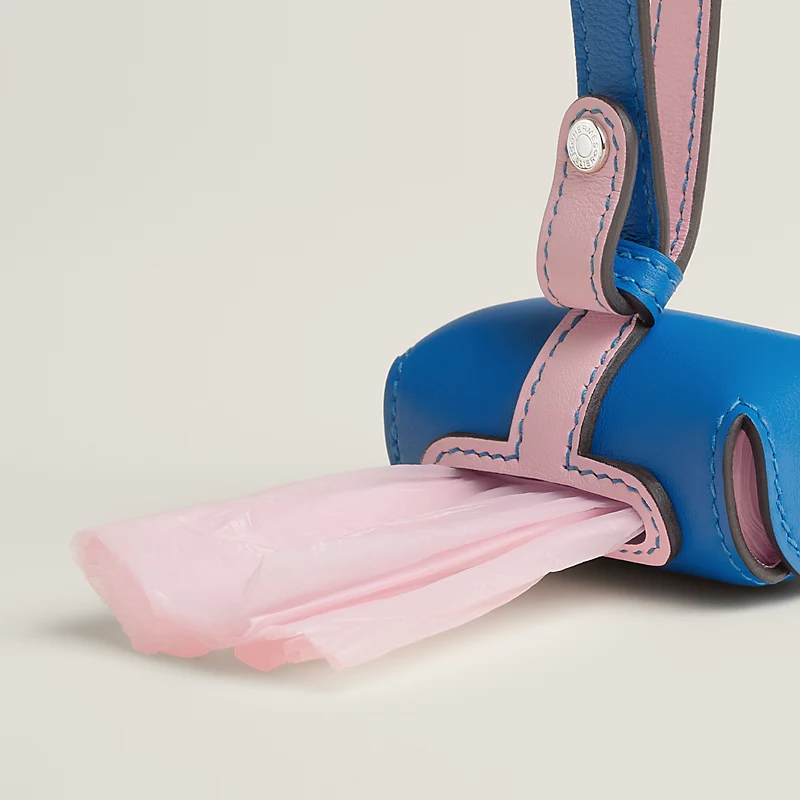
Hermès just sold a RMB 11,050 dog poop bag holder. Chinese internet went nuclear
The object is 6.8 centimetres long and 3.5 deep. Smaller than a lipstick. Swift calfskin, a 9cm leather strap so you can clip it to a handbag, a dog lead or your belt, made in France.
Inside it you put the plastic bag you are going to pick up dog mess with.
Hermès lists it at RMB 11,050. About $1,550.
The bags themselves cost a few fen each, which means the holder costs more than every poop bag that dog will ever need, several times over, with change left for the dog.
The official explanation is the best part
On 11 September, with the thing already spreading across Chinese social media, Hermès customer service explained the product to reporters.
The piece is designed specifically for dog-walking, they said. Its main function is storing pet waste bags. And it allows the act of cleaning up after your dog to become 从容且富有仪式感.
Composed, and full of ceremony.
They added that it sits closer to Hermès mini leather goods than to ordinary pet supplies, which is a category distinction of real beauty. It is not a pet accessory. It is a small handbag that happens to contain the bag you use for excrement.
Two lines went everywhere
比我的狗还贵. More expensive than my dog.
以为是装口红的皮具,没想到是装宠物捡屎袋的. Thought it was leather goods for a lipstick, turns out it's for dog poop bags.
The size did most of the damage. A RMB 11,050 dog carrier would have passed without comment, because a carrier is a big visible object that looks like it should cost something. A thing shorter than a lipstick, holding a bag worth half a fen, is a photograph that argues with itself. Comparisons to keychains and coin purses followed, all making the same point: this object did not need to exist, and it certainly did not need to exist at five figures.
And it is not even the most expensive item in the room. Hermès also sells a stainless steel dog bowl at around RMB 20,000, which produced its own round of Chinese commentary along the lines of "I assumed it was made of gold."
Why this one matters more than the usual luxury pricing joke
Expensive luxury items get mocked online every week. This one is worth your attention for a different reason.
It happened to Hermès.
In the Chinese market Hermès has occupied a position no other luxury house holds. Birkin and Kelly waitlists run for years. The brand has kept growing while LVMH and Kering post China declines, while Kering signals around a hundred China closures, while Louis Vuitton quietly exits entire provinces. Hermès pricing has been treated by Chinese consumers as a fact of nature rather than a decision anyone made.
Chinese consumers just held a Hermès price up to the light and laughed at it.
A year ago this kind of mockery landed on the second tier. It has now reached the brand that was supposed to be immune, and it landed on a functional object where the gap between price and purpose cannot be argued away with heritage.
The second-order effect is the one to watch. Chinese luxury consumers in 2026 have been running a price-versus-function audit on everything, driven by a market where the big houses are visibly retreating. This story gave them the most enjoyable possible example, attached to the brand that matters most.
The operational failure nobody is talking about
Read back over how Hermès's position got communicated.
A customer service representative fielded the question. That representative then delivered the brand's official justification for an RMB 11,050 price to national Chinese media, including the phrase about ceremony that the internet then spent three days enjoying.
Somebody on a service desk became the spokesperson for Hermès China's pricing philosophy, apparently without a script written for this situation.
It is a small thing and it is the most portable lesson in the whole story. Your China customer service team is one screenshot away from being quoted as your brand. Reporters call the number on the website, because that is the number on the website.
Five things worth doing
1. Find your own poop bag holder before somebody else does.
Go through your China product listings and look for anything where the price is many times what the object appears to do. Small, functional, and expensive is the combination that goes viral, because it photographs badly and explains itself worse.
You will probably find two or three. Decide in advance whether you are comfortable defending each one in public, and if you are not, either fix the listing photography and copy so the craft is visible, or accept the risk with your eyes open.
2. Write the price justification per SKU, in numbers, before launch.
Poetry does not survive Chinese social media. The response that works names the hours of hand-stitching, the leather grade, where it was made, and why any of that costs what it costs.
If your team cannot write three concrete sentences justifying a price, that is useful information about the price.
3. Brief your China customer service desk like a press office.
They will be called. Give them approved language for your ten most expensive and most unusual products, tell them what they may not improvise, and give them a name to escalate to within the hour.
This costs one afternoon and it is the single cheapest crisis prevention available to you.
4. Watch Weibo and Xiaohongshu on a clock measured in hours.
This story went from a product listing to national conversation without Hermès running any campaign. Listing the product was the entire trigger, and Chinese consumers did the rest for free.
Whatever monitoring you have, check that somebody is looking at it on a Saturday.
5. Look at the category seriously anyway, because the joke is not the story.
Chinese pet owners are a large, young, urban and well-paid group, and luxury houses are competing for them for a reason. Hermès already sells dog collars, leads and a very expensive bowl. Louis Vuitton, Fendi and Prada all sell pet product in China.
Chinese consumers are not rejecting luxury pet goods. They rejected one object where the price-to-purpose ratio was indefensible. If you have any pet-adjacent product, the category is real and the lesson is about ratio rather than about pets.

