Labubu just stole the World Cup opening. First Chinese IP ever to do it.
Picture this. The 2026 FIFA World Cup opening ceremony. Azteca Stadium in Mexico City, 2,200 meters above sea level. 80,000+ fans in the stands. Hundreds of millions watching live on every continent. Mexican folk dance. Latin pop. A giant golden trophy rising from the stage. Shakira waiting to close the show.
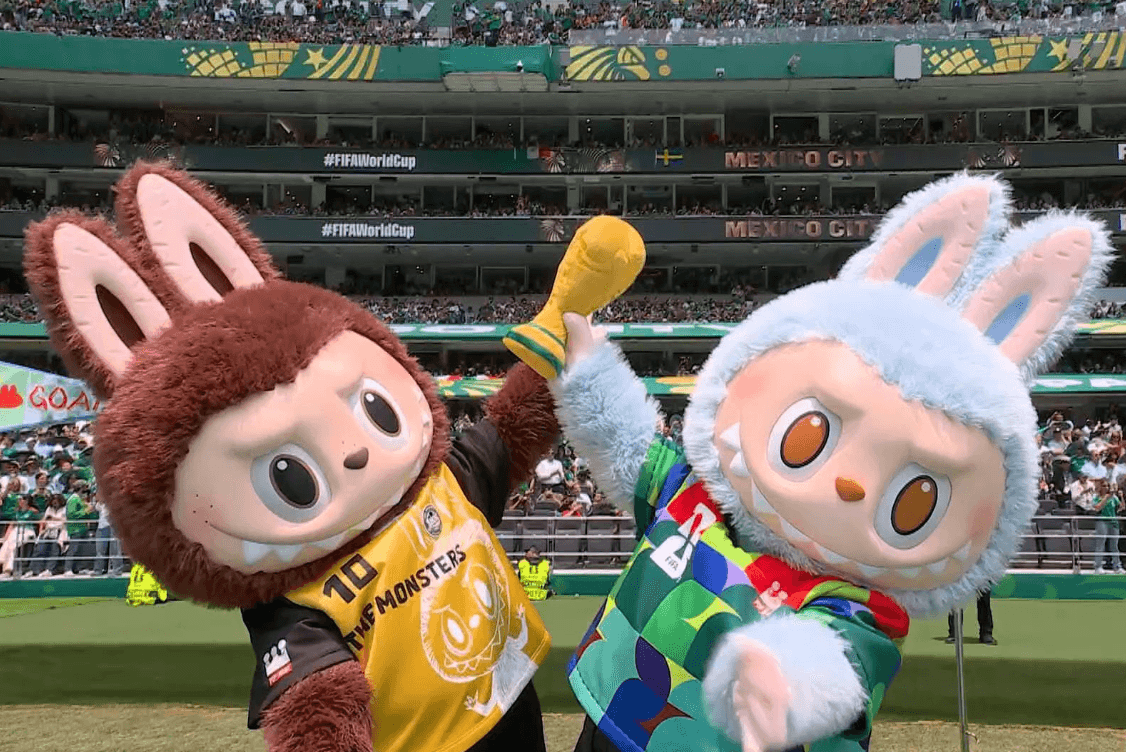
Then... two human-sized fluffy creatures bounce onto the stage. Pointy ears. Nine jagged white teeth. Quirky "ugly-cute" (chǒu méng 丑萌, "ugly-cute") faces. One in a brown jersey numbered 10. One in a blue jersey with the 2026 World Cup logo. They hold a mini Hercules trophy together. One trips over its own feet. Picks itself up. Waves. The crowd erupts.
That's Labubu. The viral Chinese pop toy character. The first Chinese original IP ever to be officially invited onto a FIFA World Cup opening ceremony stage in the tournament's 96-year history. And the moment is now changing what Chinese consumer brands believe is possible at the global level.
If you're a Western brand owner trying to understand how Chinese IP just leapfrogged onto the world's biggest sports stage, this is your June 15 case study.
What just happened
Beijing time June 12, early morning. Azteca Stadium, Mexico City. The 2026 FIFA World Cup co-hosted by Mexico, USA and Canada officially kicked off.
The Labubu sequence specifically:
2 human-sized Labubu mascots took the stage mid-program, between traditional Mexican folk dancing and Shakira's closing performance
1 wore Argentina's national team jersey, holding a mini Hercules trophy (in some camera angles the brown Labubu also wore a "#10 The Monsters" jersey)
1 wore Mexican team colors, carrying popcorn (TechNode framing); some Chinese coverage describes a blue Labubu wearing 2026 World Cup logo jersey holding a bouquet
The 2 Labubu played with each other on stage, then jointly lifted the mini trophy together
One Labubu tripped on stage, picked itself up, waved to the crowd, captured by the broadcast director with a 3-second close-up; became the "name scene" (míng chǎng miàn 名场面, "famous scene") on Chinese social media within hours
Total stage time: roughly 10-15 seconds
Their appearance introduced Colombian singer J Balvin's performance segment
Labubu also appeared in the official World Cup theme song "GOALS" music video (released May 21, 2026), wearing a custom jersey alongside Lisa (Lalisa Manobal, BLACKPINK); the MV racked up 268,000 views in the first hour
Pop Mart's "newest Labubu friend" character Little Sea Salt (xiǎo hǎi yán 小海盐, "little sea salt") also made its global public debut at the ceremony
What's behind the appearance
Labubu's road to the World Cup opening:
Created in 2015 by Hong Kong-born artist Kasing Lung as part of The Monsters franchise
Acquired by Pop Mart (HKEX:9992) as a flagship IP through Pop Mart's exclusive deal with Lung
March 25, 2026: Pop Mart announced THE MONSTERS × FIFA World Cup official licensed collaboration; Labubu became the FIRST officially FIFA-licensed designer toy IP in World Cup history (same status tier as Lego and Hasbro, not a normal sponsor placement)
April 2, 2026: THE MONSTERS × FIFA collection went on sale, including silicone-plush dolls, key tags, fridge magnets etc., priced ¥59-¥599
May 21, 2026: GOALS music video featuring Labubu alongside Lisa, Anitta, and Rema released globally
June 12, 2026: Labubu took the FIFA World Cup opening ceremony stage at Azteca Stadium
Same day: Pop Mart THE MONSTERS × FIFA collaboration collection launched simultaneously in 40+ countries and regions, online inventory sold out on Day 1
The numbers behind the commercial spike:
Pop Mart × FIFA collab sales: 30x normal Labubu sales volume after the opening ceremony appearance
Secondary market (resale) premium: 5x retail price as of June 12-13 coverage
"LABUBU goes to the World Cup" became a top-trending Weibo hashtag, joining "Labubu makes World Cup history" in the heat lists
Why this is a watershed moment for Chinese IP
For 96 years (since 1930), no Chinese-origin character had ever stood on a FIFA World Cup opening ceremony stage as an officially invited IP. The full list of cultural-IP invitees at past openings was dominated by Hollywood, European football mascots, Latin American musical acts, and Japanese gaming IP. Mascots have rotated. Performers have rotated. National-cultural-IP slots have been carefully reserved.
Labubu broke into that closed shelf.
The Chinese-language analysis on Sina Sports framed it as "three forces converging at once":
Chinese cultural IP completing soft-power global crossover: Labubu joins K-pop, K-drama, and Japanese gaming IP as a culturally-coded entertainment property that lands across language and continent
FIFA actively embracing younger and more diverse audiences: The 2026 World Cup is the first 48-team tournament with the broadest geographic and demographic reach in history. FIFA's audience-growth strategy now needs IPs that 18-30 year-olds in tier-1 Chinese, Korean, Vietnamese, Indonesian, Brazilian, and Mexican cities actually care about. Labubu fits that exact profile.
Chinese designer-toy industry completing the manufacturing-to-IP-creator shift: For 30 years China made toys for Western brands as a contract manufacturer. Pop Mart-Labubu represents the moment Chinese IP becomes the brand other countries pay to license.
The third point is the one Western brand owners should read twice. Pop Mart did not pay FIFA to put Labubu on stage. FIFA paid Pop Mart for a co-licensed collection and invited Labubu to appear. That power-direction reversal is new.
The Pop Mart financial machine behind this
Pop Mart's (HKEX:9992) 2025 results published earlier this spring showed:
2025 revenue ¥17.4B (+106%)
2025 net profit ¥3.4B (+185%)
Overseas revenue contribution at all-time-high
The Monsters franchise (including Labubu) the fastest-growing IP across the catalog
Stock up roughly 4-5x over the past 12 months
The June 12 World Cup appearance is timed to drive a second leg of the Pop Mart re-rating. Pop Mart stock moved up sharply on the news cycle. Secondary-market Labubu pricing went vertical. Online inventory in 40+ countries sold out Day 1.
This is what an IP-led Chinese brand at full global scale looks like. Pop Mart is no longer "the Chinese blind-box company." It is the most powerful character-IP brand outside Disney and Sanrio operating in 2026.
What this means for YOU as a Western brand
If you run a Western fashion, lifestyle, or sportswear brand watching the Chinese IP wave land on global stages, six things to take:
Chinese IP licensing is now a globally-relevant brand asset, not a low-stakes regional deal. A Labubu collab in 2026 will get you more cultural attention with Chinese 18-30 year-old consumers than 5 standard celebrity endorsements combined. If your brand portfolio doesn't include a Pop Mart or Sanrio Asia or major Chinese-IP collaboration in the 2026-2027 plan, you're missing the highest-impact cultural moment in young-Asian consumer commerce
The IP commercial engine is now globally distributed. Pop Mart's FIFA collab launched simultaneously in 40+ countries on June 12. Your IP partnership needs the same global distribution infrastructure or your collaboration will fail to monetize in the moment that matters
Olympic, World Cup, and global-sport moments are open-shelf opportunities for Chinese IP, which means closed-shelf moments for Western IP. FIFA chose to make Labubu the first Chinese original IP at a World Cup opening ceremony. That slot used to be filled by Disney, Hollywood, or European sports IP. Watch which IP slots open up in the next 18 months at global sports moments. Your competitors are already negotiating
The "ugly-cute" (chǒu méng) aesthetic is a real cultural force, not a fad. Labubu's design is intentionally not-cute, not-classical-beautiful, not-typical-toy. The aesthetic resonates with the Chinese post-2000 generation's "anti-perfection" cultural moment and translates surprisingly well to global Gen Z. Western brands that try to "fake-Asian" their aesthetic by adding flowers and pastels are still 5 years behind the actual cultural movement
Resale market premium is the brand-equity meter. Labubu World Cup collab hit 5x resale premium on Day 1. Track your brand's resale premium honestly. If your retail price = secondary-market price, your brand has zero scarcity equity. Pop Mart's 5x resale shows what scarcity-plus-cultural-moment looks like
Pop Mart is now a competitive lifestyle-brand competitor in China, not just a toy company. Pop Mart's POP BAKERY dessert line opens first national store June 17-19 at Aranya. Pop Mart Land theme park opening 2026. Pop Mart Beauty hinted for 2027. The brand is becoming a multi-category lifestyle empire. If your brand competes in lifestyle, fashion, accessories, or hospitality categories in China, Pop Mart is now in your competitive set
The closing thought
In 96 years of FIFA World Cup opening ceremonies, no Chinese original IP had ever taken the stage as an officially invited guest.
On June 12, 2026, two human-sized Labubu mascots changed that. They tripped, picked themselves up, waved, lifted a mini Hercules trophy together, and walked off after 10-15 seconds.
Then the secondary market Labubu pricing went 5x. The FIFA-licensed collection sold out in 40+ countries on Day 1. Pop Mart stock moved up sharply.
If your Western brand still treats Chinese IP partnerships as "small regional marketing," you're reading a 2018 playbook. The 2026 playbook is: Chinese IP is now a globally-significant brand asset. The brands that get the next 18 months of Pop Mart, Sanrio Asia, miHoYo, or NetEase IP collaborations are the brands that will own the post-2000 generation's wallet for the next decade.
Get in the room with the IP owners. Or watch Labubu wave at you from the World Cup stage.

