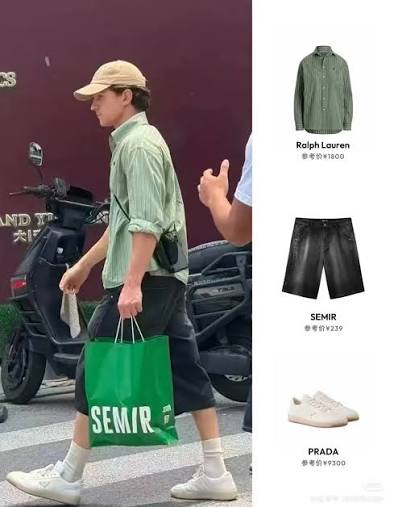
Tom Holland bought $22 shorts at a Shanghai mall. They sold out by dinner.
Every luxury brand in China pays celebrities millions per year to wear their clothes for a contractual 3-6 months. Semir (森马) got Spider-Man for RMB 159 and one air-conditioned afternoon.
On July 23, 2026, Tom Holland walked into the Semir Yuyuan Garden flagship in Shanghai, bought a pair of washed-black denim shorts off the rack, changed into them in the store, and walked out sightseeing with Zendaya. He was in town for the Spider-Man: Brand New Day press tour. The shorts retail for RMB 239, on promo for RMB 159 (~$22).
Xiaohongshu and Weibo had the paparazzi photos within minutes. "Holland brother style" (荷兰弟同款) started trending. Semir slapped "Tom Holland Same Style" labels across Douyin, Tmall, Xiaohongshu, and its own e-commerce store by that afternoon. They launched a product edit called "Shanghai is simply too hot" (上海实在太热) built around Holland's off-duty look. The shorts sold out in core sizes online before sunset.
Even the RMB 9.9 Semir shopping bag went viral.
Semir was ready for this (even though they didn't plan it)
Semir is a Wenzhou brand founded in 1996 with 7,000+ stores across China. For most of its life it was cheap basics. The brand you wore before you could afford anything else.
That changed in 2024 when Semir started rebranding as "China qualitywear" (中国品质服饰). The Yuyuan Garden flagship opened the same year as part of a push into premium retail locations. That single store did RMB 24.34 million (~$3.4M) in 2025 sales, ranking 3rd among all Semir directly operated stores. The company plans to relocate ~1,000 stores into malls, with directly operated locations expanding faster in 2026.
In April 2026, Semir ran a "Master Series" capsule pop-up at 55 Wukang Road in Shanghai with British designer Marcus Clayton (formerly Maison Kitsuné). Field jackets and bombers with functional fabrics and lightweight tailoring. The pop-up is becoming a long-term guest designer platform where popular styles get retooled for the main collection.
So when Holland walked in off the street, he walked into a brand mid-repositioning. The "qualitywear" rebrand was already live. Holland's accidental endorsement landed on top of infrastructure that was ready to catch it.
The 同款 machine runs in hours
The "同款" (tóngkuǎn, "same style") purchase framework on Xiaohongshu is a well-oiled machine. Celebrity gets photographed wearing something. Users identify the brand. Product links go up. Purchase happens. The whole cycle runs in hours because it doesn't need approval chains or legal sign-off. The paparazzi content IS the campaign.
Holland's timing made it better. Spider-Man: Brand New Day hit Chinese theaters on July 29 and opened to $37 million, the biggest superhero opening day in China in 7 years. Maoyan projects a total China run of ~$255 million (RMB 1.73 billion). Holland was the most searched foreign celebrity in China that week. The shorts story was circulating alongside every Spider-Man headline.
One more tailwind: Chinese Gen Z consumer sentiment has shifted toward domestic premium brands. Per our June 2026 coverage of the Tmall 618 premium apparel breakout (Songmont, Pane Fabrique, Icicle, Bosideng), consumers are paying RMB 500-2,000 for Chinese apparel they used to only pay for imports. Semir at RMB 159 sits below that premium band but adjacent to it, at the midmarket price point where global celebrity purchase behavior has the biggest social multiplier.
Your celebrity endorsement math is probably wrong
Luxury brands spend millions per year per celebrity for a contracted 3-6 month endorsement window. The celebrity posts approved photos at scheduled events and disappears when the contract ends. ROI gets measured in "impressions" because the sales lift is embarrassingly hard to prove.
Holland's Semir moment cost the brand zero. He walked in, bought shorts, changed into them on the spot, and walked out. The entire earned media cycle from paparazzi photo to sold-out SKU took less than 8 hours. Semir's social team spun up a product edit ("Shanghai is simply too hot") within the same afternoon.
If your brand's social team can't launch a product edit within 3 hours of an organic celebrity moment, you're slower than a Wenzhou basics brand that rebranded 2 years ago.
Steal this
Build the infrastructure before the accident happens. Semir's "qualitywear" rebrand, flagship store upgrade, designer collaborations, and social commerce speed were already in place when Holland walked in. The brand had a story worth telling. If Holland had walked into the old Semir, it would've been a punchline.
Speed kills in Chinese social commerce. "Tom Holland Same Style" labels across e-commerce platforms by that same afternoon. Product edit named and launched within hours. If your e-commerce team needs 48 hours and a deck to react to an organic celebrity moment, you'll miss it every time.
Audit your endorsement ROI. If your contracted celebrity's platform content generates less earned media than an unplanned paparazzi photo at a midmarket store, the endorsement economics don't add up. Holland gave Semir more viral coverage in one afternoon than most brands get from a full-quarter celebrity contract.
Your shopping bag is a brand touchpoint. Semir's RMB 9.9 bag went viral as a meme alongside the shorts. Bags, receipts, in-store interiors, price tags: make sure they're all worth photographing.
Tom Holland bought shorts for RMB 159 at a Shanghai mall. They sold out by dinner. The brand that caught the moment had spent 2 years rebuilding itself from cheap basics into "China qualitywear." The accident worked because the preparation was already done.

