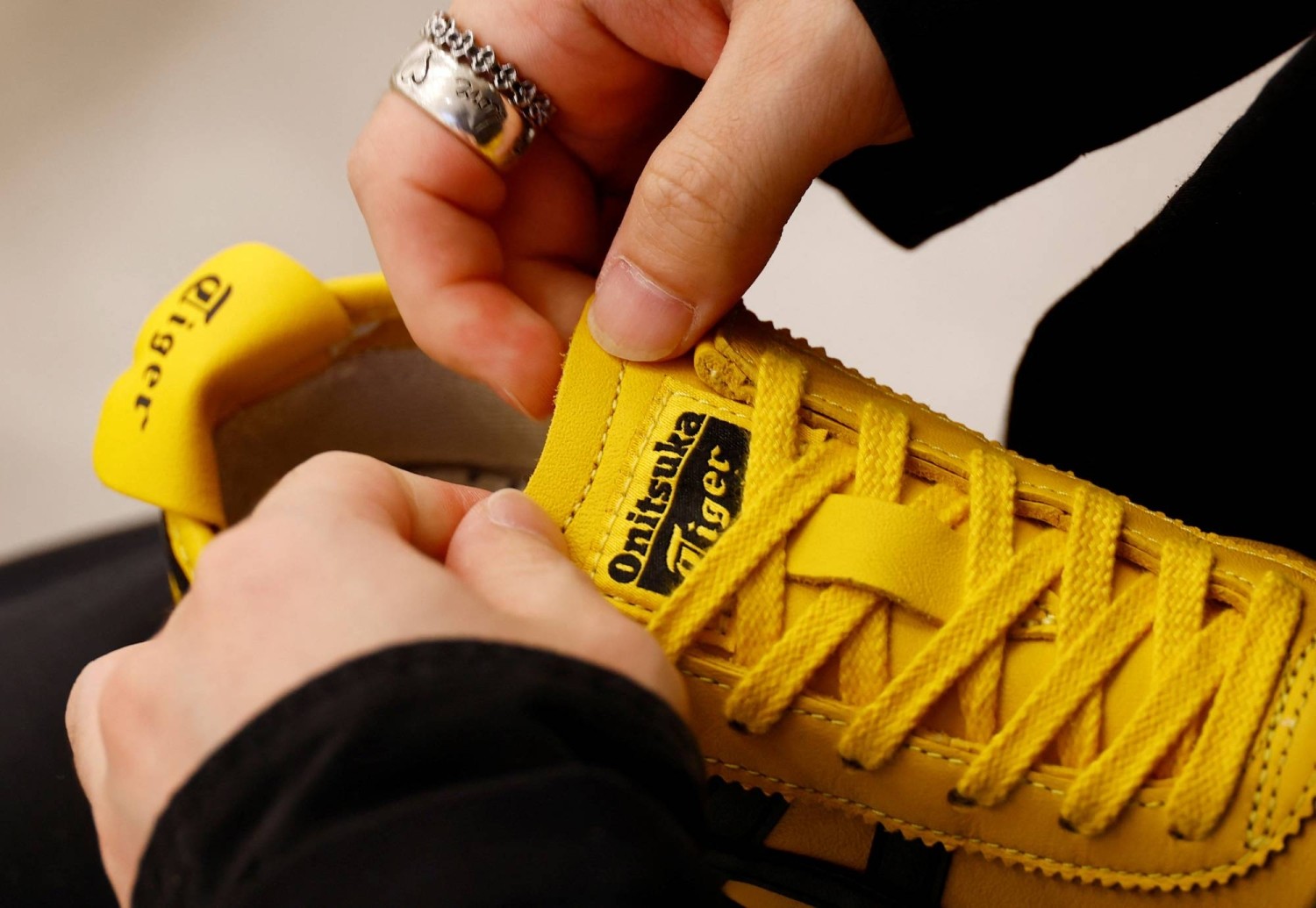
Asics is spinning out Onitsuka Tiger. $851M brand goes solo Jan 2027.
For 8 decades, Onitsuka Tiger was the lifestyle sibling that lived under Asics's roof, paid its rent, and never asked for its own bedroom.
That ends on January 1, 2027.
On June 10, Asics Corporation (Tokyo:7936) announced that its board approved a simplified absorption-type company split that will transfer the entire Onitsuka Tiger business into a wholly-owned subsidiary called OT GROUP Corporation. New Tokyo headquarters at 2-14-4 Kita-Aoyama, Minato-ku. New CEO: Ryoji Shoda. Same 100% Asics ownership. Independent operating structure. Effective January 1, 2027.
This is the biggest sportswear-to-luxury-lifestyle brand spin-off announced this decade. And it tells you something specific about how the next 5 years of sportswear-and-lifestyle convergence in China will look.
The split, in plain terms
The Asics June 10 board resolution:
Effective date: January 1, 2027
Mechanism: simplified absorption-type company split (Article 784, Paragraph 2 of Japan's Companies Act allows it without a shareholders' vote)
OT GROUP Corporation: established February 2026, 100% Asics-owned
Headquarters: Tokyo (2-14-4 Kita-Aoyama, Minato-ku); Asics HQ remains in Kobe
Capital: OT GROUP starts with ¥376 million paid-in
OT GROUP CEO: Ryoji Shoda
Asics CEO: Yasuhito Hirota (parent); President and COO of Asics: Mitsuyuki Tominaga
Shareholders' meeting to approve absorption-type split agreement: November 16, 2026 (scheduled)
Consideration: OT GROUP issues 400 new common shares to Asics
IPO plan: Asics CEO Hirota said publicly there are no plans to take OT GROUP public
Group financial impact: minimal (internal reorganization between parent and wholly-owned subsidiary)
The mechanics are technical, but the strategic intent is the headline: Onitsuka Tiger gets its own CEO, its own corporate identity, its own decision-making cadence, while keeping the full backing of Asics's manufacturing, R&D, and group financial strength.
The numbers that forced the split
Read why Asics did this. Onitsuka Tiger's 2025 numbers are extraordinary:
FY2025 sales: ¥136.5 billion (~$851 million USD)
FY2025 sales growth: +43% YoY
FY2025 segment profit margin: nearly 38% (highest among Asics's 5 core categories)
Profit growth contribution: 4 consecutive years of record profit for Asics
3-year sales trajectory: ¥60.3B (FY23, +40.2% YoY) → ¥95.4B (FY24, +58.3%) → ¥136.5B (FY25, +43.0%)
Sales already approaching the Asics "Sports Style" segment: FY25 Sports Style segment ¥141.3B (+43.6%), Onitsuka Tiger ¥136.5B; the two are basically twins in revenue terms
Q1 FY26 (ended March 31, 2026) Onitsuka Tiger sales: ¥37.9B (+33.8% YoY)
Q1 FY26 Sports Style segment: ¥59.6B (+69.6% YoY)
Q1 FY26 Performance Running segment: ¥116.7B (+19.1% YoY)
Asics FY25 consolidated net sales: ¥810.9 billion
Asics FY25 operating profit: ¥142.5 billion
Asics FY25 net profit attributable to parent: ¥98.7 billion
Onitsuka Tiger now generates 38 cents of segment profit on every dollar of segment revenue. The mainstream Asics running shoe business generates far less. The lifestyle sibling is now the highest-margin part of the household.
When a subsidiary becomes more profitable per dollar than the parent's flagship business, governance separation becomes the right answer. Mixing the two on a single P&L hides operational decisions that need to happen at very different cadences.
The "fashion-and-sport" identity problem
CEO Hirota and OT GROUP's incoming CEO Ryoji Shoda framed the spin-off around a structural identity problem: Onitsuka Tiger is increasingly a "luxury lifestyle brand" while Asics is a "professional sportswear brand." Two different customer mindsets. Two different marketing cadences. Two different retail strategies.
The most telling detail in the press cycle: Shoda said publicly that Onitsuka Tiger's 2023 withdrawal from the US market was partly due to a "conflict in approach" between Asics America management and Onitsuka Tiger management. Translation: the two brands had been fighting internally over US retail strategy and Onitsuka Tiger lost. The brand had to retreat from a major market because the parent-brand operating team was running an Asics-led playbook on a Onitsuka Tiger asset.
The spin-off prevents that from happening again. Onitsuka Tiger now has its own decision rights, its own regional subsidiaries, its own retail strategy, its own design and marketing voice. The pace can be faster. The customer can be different.
Asics CEO Hirota's framing: "Onitsuka Tiger will gain the autonomy to operate more independently from Asics." Bernstein analysts called the new structure a "one parent, two brands" framework.
The China angle
For the Chinese consumer, Onitsuka Tiger sits in a specific cultural slot: it's the Japanese heritage sneaker brand that has been adopted by Chinese fashion KOLs and lifestyle influencers since the early 2010s, with retro-Japan styling that fits both Chinese workwear-coded streetwear and Chinese minimalist neutral-tone fashion. The brand has Tmall flagship presence, Tier-1 city retail flagships, and a credible Xiaohongshu following.
Three structural reasons the spin-off matters for Onitsuka Tiger's China runway:
Faster product-drop cycles: Independent decision-making means Onitsuka Tiger can launch China-specific capsule drops without competing for Asics's design and supply chain attention against the next Asics flagship running shoe
Different retail strategy: Onitsuka Tiger can pursue luxury-corridor flagships (the kind of move Massimo Dutti just made at Hong Kong Plaza Shanghai) without forcing Asics to compete for the same mall positioning
Cleaner brand storytelling: When the brand sits inside Asics, the marketing positioning gets diluted ("performance sneakers AND lifestyle"). When the brand has its own CEO, the positioning can be sharpened ("Japanese luxury lifestyle, heritage runners")
The Chinese consumer who buys Onitsuka Tiger today is not the consumer who buys an Asics Gel-Kayano 31. The brands need to talk to different rooms, in different voices, at different moments. A separate operating company makes that possible.
What this means for YOU as a Western brand
If you run a Western fashion, lifestyle, or sportswear brand with multiple brands under one corporate roof, the Asics spin-off is a 2026 governance memo. Six things to take:
Internal brand cannibalization is real. Operational separation is the antidote. If your portfolio's high-margin lifestyle brand keeps losing internal arguments to your volume-led performance brand, separate them. The Onitsuka Tiger 2023 US withdrawal proves the cost of NOT separating is concrete.
Profit-margin asymmetry is the trigger. When one brand inside your portfolio crosses 35-40% segment margin while others sit at 10-15%, the strategic answer is to give the high-margin brand its own corporate room. Don't drag it down to the average.
The "one parent, two brands" structure is the most efficient. Keep 100% ownership. Keep shared manufacturing and supply chain backbone. But give each brand its own CEO, board, and decision authority. Asics, LVMH, and Kering all do versions of this.
China retail strategy benefits the most from operational separation. A luxury-coded lifestyle brand inside a performance-coded parent will always lose the Chinese tier-1 luxury-corridor flagship discussion. Separating gives the lifestyle brand permission to chase real estate the parent wouldn't have approved.
Western brand owners eyeing Onitsuka Tiger as competition should expect acceleration. The brand has gained the political capital to act faster, drop more aggressive capsules, sign more cultural collabs, and push higher pricing. If your brand sits in the same lifestyle-sneaker slot, the next 3 years just got harder.
The IPO question is the wrong question. Hirota said no IPO planned. That doesn't mean it won't happen in 5 years. But the immediate value-unlock is operational, not financial. Western brand owners obsessed with IPO timing are missing the deeper play: independent operating cadence drives long-term valuation, IPO or no IPO.
The closing thought
Onitsuka Tiger crossed ¥136.5 billion in 2025 sales with a nearly 38% profit margin and 43% growth, becoming the highest-margin business inside Asics by a wide margin. Asics could have kept the brand under its roof for another decade and harvested the cash flow. Instead, the Asics board chose January 1, 2027 as the date the lifestyle child moves into its own house.
This is the right call. High-margin lifestyle brands don't grow at the cadence performance-running parent brands run on. The mix slows the strong, and the strong drags up the weak. Separation lets both run their own race.
If you run a multi-brand Western fashion or sportswear house with one quietly-outperforming brand in the lifestyle slot, your Friday afternoon should be spent reading the Asics June 10 press release in full. Then asking yourself whether your own portfolio's quiet outperformer deserves the same room.
The Asics governance trick is now in the open. The next 5 brand spin-offs will be reactions to this one.

