China’s 2025 Shopping Habits Make No Sense. Until You Look Closer.
If 2025 consumer behavior feels contradictory, that’s because it is.
On one hand, shoppers are calculating every detail of a 9-yuan bag charm. On the other, they’re casually dropping 9,000 yuan on a premium down jacket. This isn’t irrational spending. It’s the new logic of consumption.
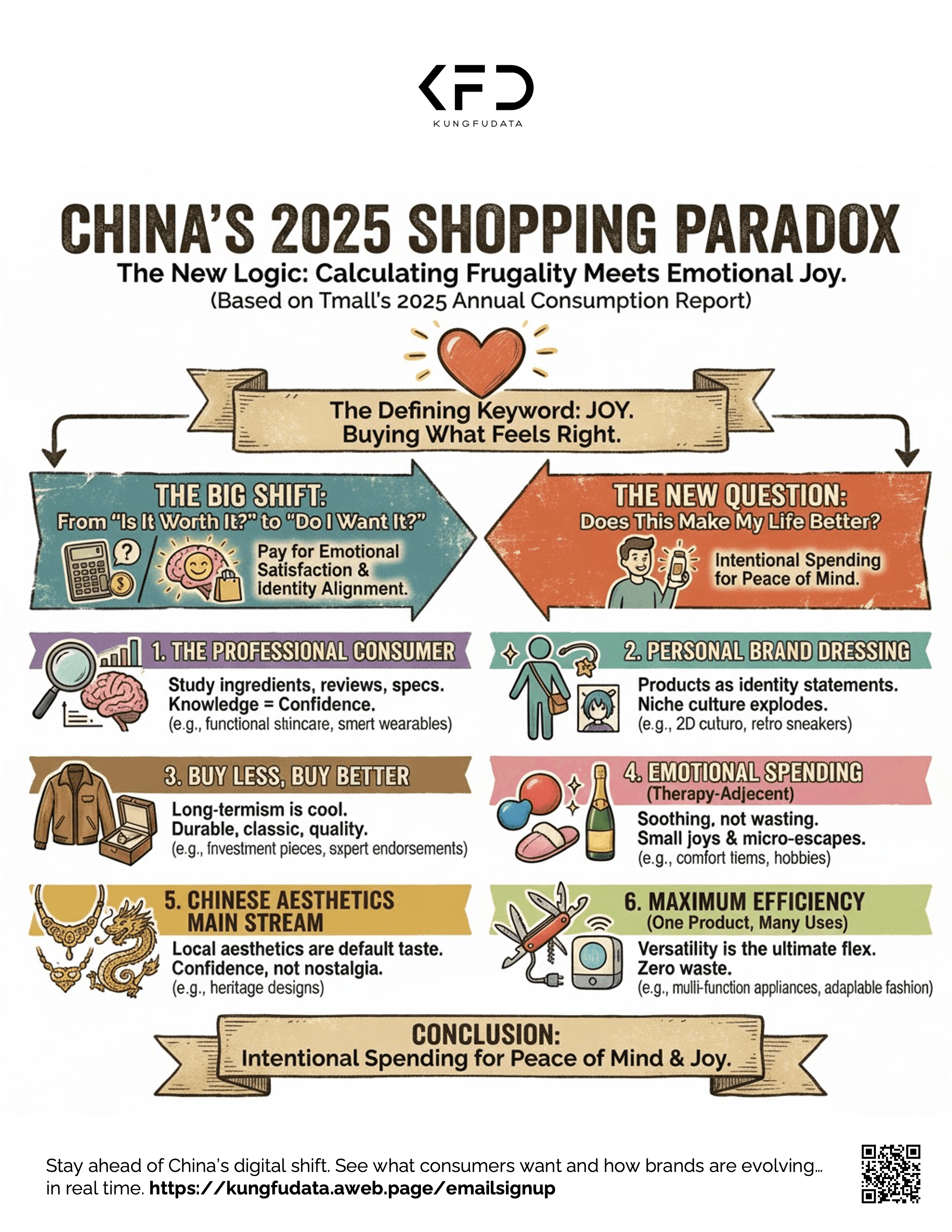
According to Tmall’s 2025 Annual Consumption Report, the defining keyword of the year isn’t “cheap,” “luxury,” or even “value.” It’s something much more emotional.
Joy.
Consumers aren’t trying to buy less. They’re trying to buy better. Or more accurately, they’re buying what feels right.
The Big Shift. From “Is It Worth It?” to “Do I Want It?”
For years, shopping was framed around value for money. In 2025, the framing has changed.
People are increasingly willing to pay for emotional satisfaction and identity alignment. The underlying mindset sounds like this. It may be hard to please myself, but if it makes me happy, I’ll spend.
This explains why extreme frugality and premium spending now coexist in the same cart.
Trend 1. The Rise of the “Professional Consumer”
Today’s shoppers don’t just buy products. They study them.
Ingredients matter. Specifications matter. Reviews matter. Consumers want the product that fits them, not the one with the loudest marketing.
Functional skincare has seen double-digit transaction growth. Searches for high-performance outdoor fabrics surged over 100 percent going into winter. Smart wearables like fitness bands and watches grew nearly 50 percent year over year.
This isn’t about showing off. It’s about control. Knowledge is the new confidence.
Trend 2. Dressing for Your Personal Brand
Every purchase is now a statement.
Consumers increasingly see products as extensions of their identity. Whether it’s anime-inspired items, personalized bags, or smart accessories, shopping has become a way to say this is who I am.
Niche categories are exploding. Two-dimensional culture products saw triple-digit growth during major shopping festivals. Ear-clip headphones recorded over 200 percent growth. Retro sneakers and trail running shoes surged in both supply and search volume.
Style isn’t about trends anymore. It’s about storytelling.
Trend 3. Buy Less. Buy Better. Keep It Longer.
Long-termism has quietly become cool.
Instead of chasing seasonal trends, consumers are gravitating toward timeless designs and durable materials. Classic bags. Investment jewelry. Versatile outerwear.
Down jackets around the 2,000-yuan price point have become the new “sweet spot,” setting a fresh baseline for quality. People are also researching before buying, checking certifications, clinical data, and expert endorsements.
Spending hasn’t slowed. It’s just gotten smarter.
Trend 4. Emotional Spending Is No Longer Guilty Spending
Consumers aren’t “wasting money.” They’re soothing themselves.
Stress-relief gadgets, AI companion toys, and hobby-friendly products are booming. Some categories saw growth of 500 percent or more. Cozy home items, plush slippers, and comfort-driven design choices are now everyday essentials, not indulgences.
Even alcohol consumption tells the same story. Sparkling wine transactions rose over 70 percent. Small joys. Light celebrations. Micro-escapes.
In 2025, spending is therapy-adjacent.
Trend 5. Chinese Aesthetics Go Mainstream
What used to be niche is now dominant.
Traditional gold jewelry inspired by ancient craftsmanship is reshaping the jewelry market. Mythology-based IPs are attracting millions of buyers. Eastern motifs are no longer “cultural.” They’re fashionable.
This isn’t nostalgia. It’s confidence.
From Chinese-style jackets to modernized heritage designs, local aesthetics are becoming default taste, not alternative taste.
Trend 6. One Product. Many Uses. Maximum Efficiency.
The ultimate flex in 2025 isn’t luxury. It’s versatility.
Consumers love products that feel like Swiss Army knives. Smart home appliances with multiple functions are hot sellers. Intelligent pet-care products are becoming integrated ecosystems. Electric adjustable beds doubled in sales. Modular sofas grew 50 percent.
Even fashion reflects this logic. Structured down jackets that work for commuting, travel, and daily wear saw sales jump more than sixfold.
One item. Many scenarios. Zero waste.
So What Are People Really Buying in 2025?
They’re buying peace of mind, identity, and joy that feels justified.
This is not a generation that wants more stuff. It’s a generation that wants the right stuff. Sometimes cheap, sometimes expensive… Always intentional.
The age of “should I buy this?” is fading.
The new question is simpler. Does this make my life better?
And in 2025, that answer is driving everything.

