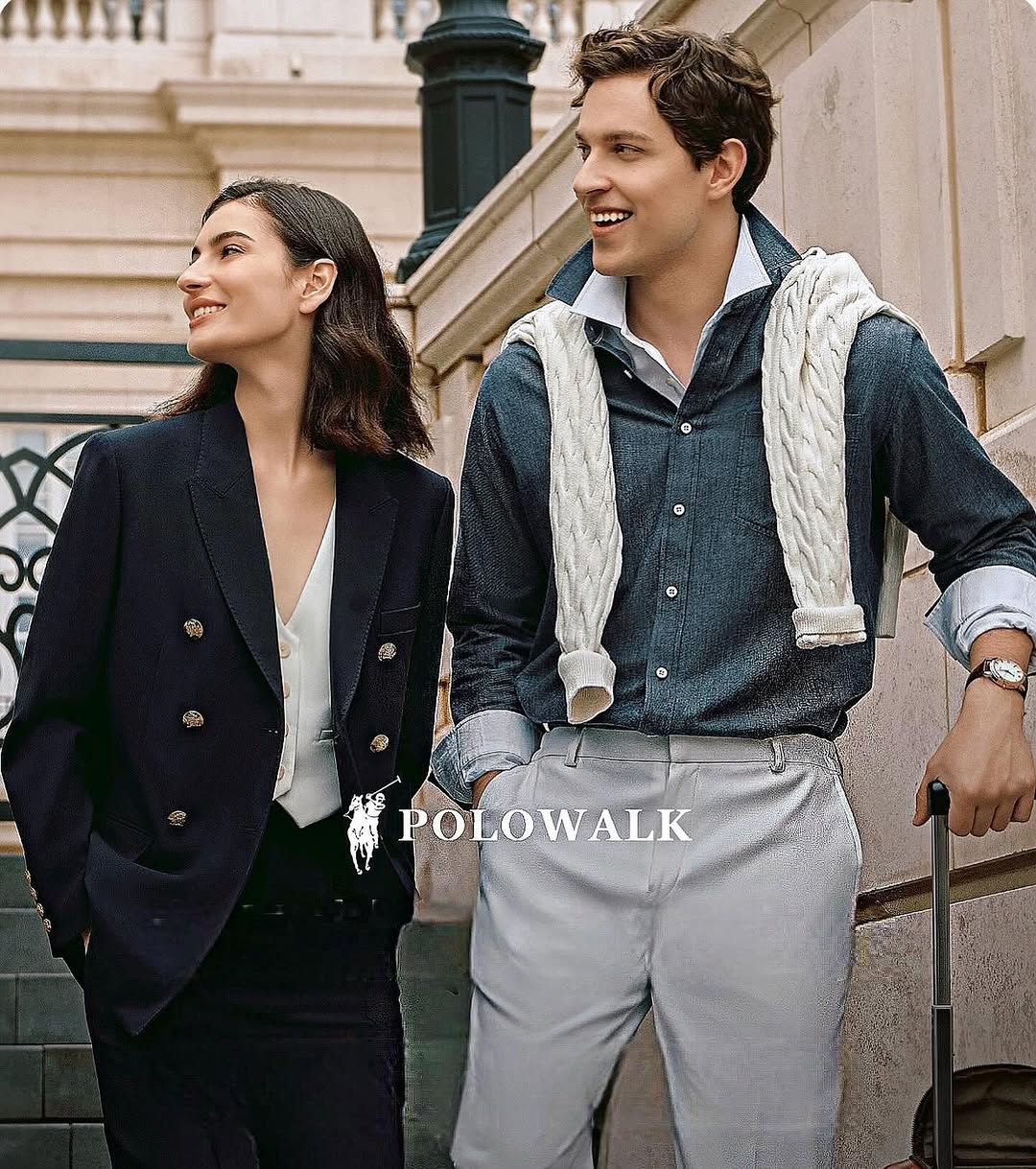
2,000+ Stores. A Backwards Polo Logo. And China's Middle Class Can't Stop Buying It.
How a shameless Ralph Lauren knockoff called POLOWALK became the most beloved "fake" brand in China - and what it tells you about where Chinese consumers are actually headed.
A man walks into a Beijing department store on a Sunday afternoon. He passes a knockoff Lacoste shop. He passes a state-enterprise-chic menswear brand that looks like it supplies uniforms to government offices. Then he stops.
Green storefront. Wooden floors. Black-and-white photos of horses and European landscapes. A poster that reads "Hourseback is Life." He's looking at POLOWALK - a brand that is, by every measure, a shameless clone of Ralph Lauren.
He picks up a sweater. Tries it on. Walks out wearing it.
Price paid: 129 RMB. That's about $18.
The Brand That Nobody's Embarrassed to Buy (Anymore)
Here's what makes POLOWALK different from your average knockoff hiding in an outlet mall: it's not hiding at all.
POLOWALK has over 2,000 stores across 30+ provinces in China. For context, Ralph Lauren has 582 company-operated stores globally. The knockoff has nearly 4x the store count of the original... in a single country.
The stores aren't tucked in back alleys either. POLOWALK sits on Beijing's Xinjiekou, Shanghai's Nanjing East Road, Guangzhou's Beijing Road - prime real estate in Tier-1 cities.
Online, the brand's Taobao flagship has nearly 950,000 followers. A single women's knit top priced at 184 RMB (~$25) moves 2,000+ units a month. Over 22,000 people have purchased prepaid shopping credits. POLOWALK has built an entire e-commerce ecosystem: kids' stores, discount outlets, "simple style" shops, and even unauthorized-looking stores with names like "POLOWALK Authentic Mall."
Strip away the logo controversy, and POLOWALK is performing better than most legacy domestic fashion brands.
"Everything's Great... Except the Logo"
This is the running joke on Chinese social media. POLOWALK buyers fall into three camps:
The "accidentally walked in, mysteriously tried something on, walked out wearing it" crowd
The buyers who immediately Google "how to remove a knockoff logo" the second they get home
The loyal fans who buy every season and every season ask: "POLOWALK, when are you going to fix that terrible logo?"
The logo is... bold. POLOWALK's rider leans the opposite direction from Ralph Lauren's. The polo player swings backhand instead of forehand. That's it. That's the difference.
Some people rip it off. Some iron patches over it. Some have evolved past caring entirely: "I look good. Let Paul take his walk."
Why It Actually Works
Forget the logo for a second. Here's what POLOWALK gets right:
Design that reads as "expensive." The brand copies Ralph Lauren's greatest hits with surgical precision: polo shirts, cable-knit cardigans, cotton Oxford shirts, khaki jackets, baseball caps. But it also pulls from Canada Goose (puffer jackets), Loro Piana (red cashmere-style cardigans), and Barbour (waxed-look field coats). Chinese internet users call it "the real Muji" - no logo and it'd be perfect.
Materials that hold up. Polyester dominates the outerwear, sure. But the shirts? One is labeled 100% cotton. Another: 59.1% linen, 40.9% cotton. In a Beijing department store, a woman in her 50s picks up a shirt, feels the fabric, and announces to her friend: "Pure cotton. And honestly, this color is gorgeous."
Pricing that kills the competition. Shirts run 150-300 RMB ($20-40). The cheapest knitwear starts at 129 RMB ($18). A tagged-at-2,330-RMB puffer jacket sells for 699 RMB ($95) after "discounts." Compare that to Ralph Lauren, where a basic polo starts north of 1,000 RMB.
One buyer put it perfectly: "I spent two days agonizing over whether to buy Ralph Lauren on installment. Then I saw POLOWALK had the same thing for 100-something RMB. Paid in full. Immediately."
Family-friendly practicality. Walk into a POLOWALK store and you'll see moms with teenage daughters, husbands trailing behind, grandmothers tagging along. Everyone finds something. The "Old Money" aesthetic is the surface. Practicality is the foundation. That's why Chinese shoppers affectionately call the brand "Paul's Stroll" or "Paul Taking a Walk."
The Legal Saga Behind the Polo Wars
POLOWALK didn't appear out of nowhere. It evolved from something messier.
In 2013, a company called "American Polo" bulk-registered disputed POLO trademarks in China, including "POLO SPORT," "POLO," and "POLO BY RALPH LAUREN." By 2016, those trademarks were transferred and licensed to Chinese companies, who then spawned dozens of POLO-adjacent brands. Walk down any major pedestrian street in China and you'd swear you stumbled into a "POLO Land" theme park - POLOSHIELD, POLO YNDON, DIV.POLO, POLOWALK, all within eyeshot of each other.
The parent company behind POLOWALK is Shanghai Hezhao Fashion (和兆服饰). Hezhao originally operated under the POLO SPORT name and scaled aggressively - opening 100+ stores in major cities within a year, once launching 8 stores in a single day.
Ralph Lauren fought back. Hard. After an 8-year legal battle, a Chinese court ruled in December 2024 that the infringers owed 20 million RMB (~$2.7M) in damages, four times the statutory cap of 5 million RMB.
POLO SPORT was officially dead.
POLOWALK was its reincarnation. New name, same backhand-swinging logo.
The Plot Twist: They Share the Same Factory
Here's where it gets wild.
A research report on Shengtai Group, one of China's top garment manufacturers, lists its top seven OEM clients. Among them: Uniqlo, Ralph Lauren... and Shanghai Hezhao (POLOWALK's parent company).
Shengtai has been manufacturing for Ralph Lauren since 2007. It started working with Hezhao in 2016. The knockoff and the original are, quite literally, coming off the same production lines.
"Different parents, same DNA" doesn't begin to cover it.
What This Tells You About Chinese Consumers Right Now
POLOWALK isn't just a funny knockoff story. It's a signal.
Chinese middle-class consumers aren't chasing logos the way they used to. The shift is real: people are "de-mystifying" (祛魅, qu mei) luxury brands and asking a brutal question - "Why am I paying 10x for a logo when the fabric and fit are the same?"
After getting burned by fast fashion's disposable quality and Taobao's "model photo vs. reality" bait-and-switch one too many times, shoppers are landing on a pragmatic conclusion: a 200 RMB shirt that fits well and lasts is worth more than a 2,000 RMB logo.
POLOWALK thrives in that gap. It's not aspirational. It's functional. And increasingly, that's what wins.
Lessons for Brands Watching China
Logo fatigue is real. Chinese consumers - especially the post-pandemic middle class - are increasingly resistant to paying premiums for brand names alone. If your China strategy depends on logo recognition doing the heavy lifting, you're exposed.
"Good enough" is the new premium. POLOWALK proves that consumers will reward quality-to-price ratio over brand prestige. Your competitors in China aren't just other international brands. They're domestic players offering 80% of your product at 10% of your price.
Legal wins don't kill demand. Ralph Lauren won the lawsuit. POLOWALK changed its name and kept going. The market appetite for affordable "Old Money" style didn't disappear just because a court ruling did. If the demand exists, someone will fill it.
Supply chains don't lie. When your knockoff competitor is literally using the same factories as you, the "quality gap" argument collapses. Consumers are figuring this out faster than brands want them to.
If you're an international brand entering China and your pitch is still "we're premium because we're foreign"... POLOWALK just sold another 2,000 sweaters while you read this sentence.

