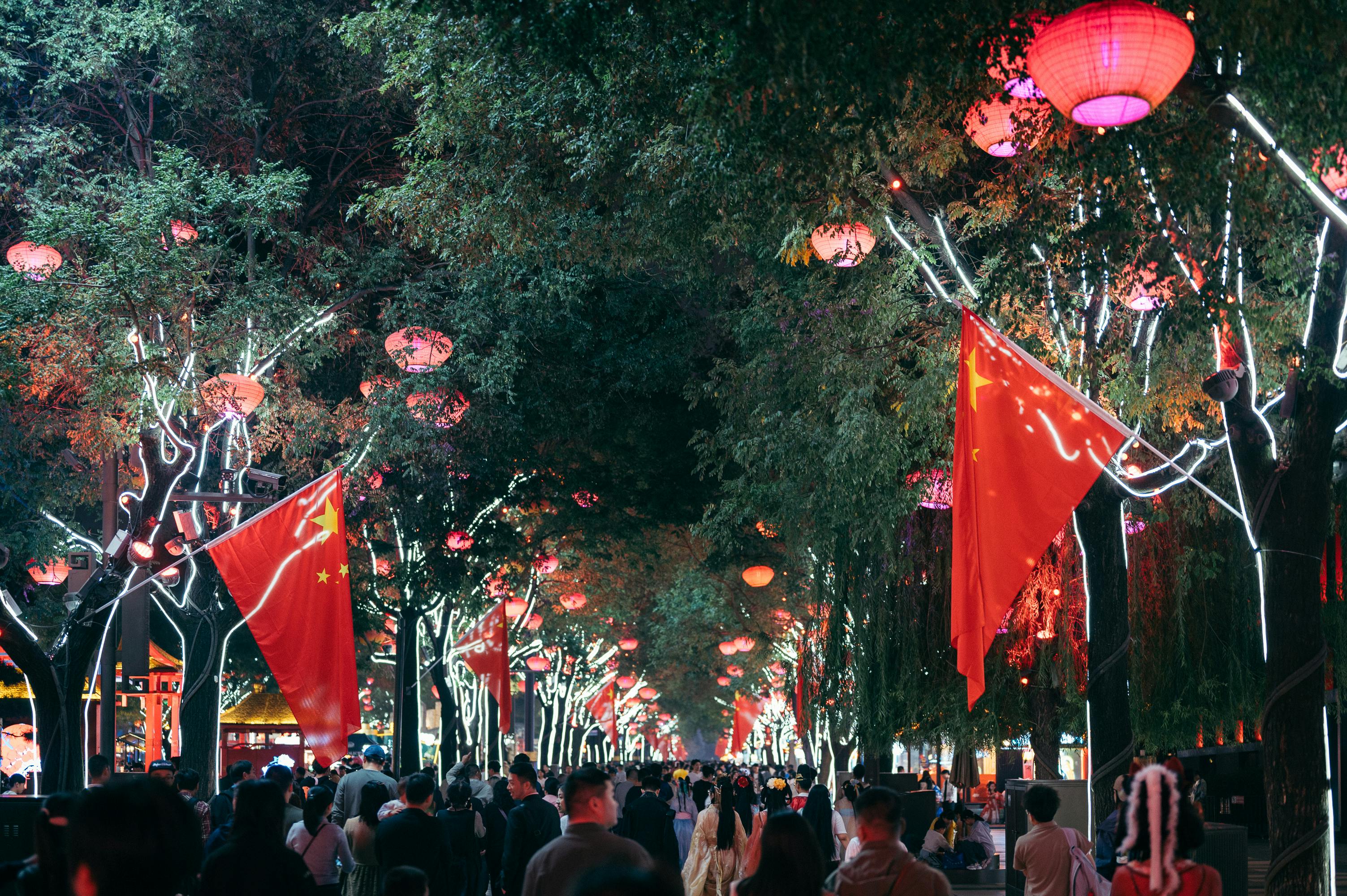
344 Million Trips on Day 1 of May Day. The Consumer Map Just Redrew Itself.
May 1, 2026. Day one of China's five-day Labor Day holiday.
344 million inter-regional passenger trips on day 1, up 3.4% year-on-year and a record for any May Day first day. The Ministry of Transport projected 1.52 billion trips across the full five days, averaging 304 million per day, up 4% year-on-year. Tourism spending projected well above 2025.
And inside all that motion, one very specific number: dining per-capita spending dropped year-on-year.
Chinese consumers spent more money than ever. They just stopped spending it on meals at restaurants. Here's what they spent it on, and why this matters for every Western fashion, lifestyle, and performance brand looking at China.
Quick unit note before we go further: in Chinese reporting these numbers come in 亿 (yì), where 1 yi = 100 million. The Ministry of Transport's 3.44 yi day-1 number is 344 million in English. Each "trip" counts every segment of a journey (so a person taking a high-speed train + subway + taxi can produce 3 trips). It is a transport-system volume metric, not a person count. China's population is roughly 1.4 billion, so the trip number tracks intensity of movement, not unique travellers.
What Actually Happened
The Ministry of Transport data for May 1, 2026 captured a clean structural shift. Overall retail and services spending rose. But inside that rise, the categories reshuffled.
What grew:
Concerts, music festivals, and live performance tickets
Outdoor and sports-related spending (camping, hiking, cycling, rock climbing)
Tourism and accommodation (up 4% year-on-year cross-regional movement)
Cultural and experience-driven retail (museums, art pop-ups, themed markets)
Gold and jewelry (Q1 2026 category already up 12.6% year-on-year)
What shrank:
Dining per-capita spend (individual meal sizes dropped)
Chain restaurant average ticket
Traditional department store footfall
Luxury leather goods and logo-heavy fashion
Conventional "go shopping at a mall" consumption
Chinese consumers are still spending. They're just spending differently. Experiences beat things. Doing beats owning. Stories beat status. This is not a slogan. It's the data.
Why This Is Happening
Three structural forces converged. They were all visible separately. May Day 2026 is where they compound.
Force 1: Rational luxury consumption is the new normal. Fashionbi's April 2026 analysis put it bluntly: "the hypergrowth era, sustained by pandemic-based spending concentration, rising affluence, and uncritical aspirational consumption, is over." Chinese consumers in 2026 are more selective, more value-oriented, and more focused on long-term wearability and resale retention. A 30,000 yuan handbag purchase requires more justification than it did in 2019. A 2,000 yuan concert ticket at a Mayday (五月天) show requires none.
Force 2: The "gao xing jiu shi yi qie" (高兴就是一切, "being happy is everything") mindset. Younger Chinese consumers, particularly the 22-35 cohort, are openly prioritizing emotional and experiential purchases over asset-like purchases. The Rednote trend this holiday: "feng ai" (疯爱, "crazy love") for concerts, festivals, and niche experiences. Tickets for Mayday's 25th anniversary tour at Beijing's Bird's Nest (April 30 to May 18, 10+ performances) sold out in minutes. Jolin Tsai, Time Youth League, Xue Zhiqian, Fenghuang Legend, G.E.M., Zhou Shen all toured this holiday.
Force 3: Content platforms drive experiential spending, not product spending. Rednote (Xiaohongshu) and Douyin reward content showing experiences over content showing purchases. A post of you at the 2026 Strawberry Music Festival in Beijing gets more engagement than a post of your new handbag. Engagement drives identity. Identity drives spending. And the spending goes where the engagement goes.
The net effect: the Chinese consumer spent more this May Day than last May Day. Fashion brands selling "things" captured less of it. Experience brands captured more.
What This Means for Fashion and Lifestyle Brands
If you're a Western fashion, lifestyle, or performance brand operating in or entering China, the May Day 2026 data should reshape how you think about Chinese retail.
Your store is not a store anymore. It's a stage. Brands winning in 2026 China turned stores into destinations: Brunello Cucinelli's "villa" flagships, Ralph Lauren's 1,000-square-meter Chengdu flagship with in-store Ralph's Coffee and Ralph's Bar, Kolon Sport's hiking-themed flagships with in-store climbing walls. The store has to reward the trip. It has to generate content. It has to feel like something worth posting about.
Product pipeline has to include experience-bundled items. A handbag by itself is an object. A handbag bundled with a private viewing at your flagship, a signature fragrance mist, a personalized monogram event, and a Rednote-worthy unboxing moment is a story. Chinese consumers buy stories now. If your product is just a product, it competes on price. If it's a story, it competes on meaning. The margin gap is obvious.
Performance brands have the easiest path. Outdoor, running, hiking, climbing, and cycling brands are in the category that's winning. Every Chinese May Day tourist who tried trail running, hiked a mountain, or joined a group cycling tour came home with an opinion about which shoe worked, which rain jacket actually breathed, and which pack fit. Performance brands that showed up at the right trailhead, the right marathon, the right river park, captured this spending directly.
Avoid the "food court" positioning. Dining per-capita dropped this May Day because Chinese consumers are cutting the category that has no story. Generic food. Generic chains. Food courts in malls. If your brand positioning is functionally equivalent to "a meal in a mall food court" (cheap, fast, interchangeable), you're in the category people are pulling back from. Fashion brands that treat their product as a fashion utility (wear it, forget it) are in the same category. Fashion brands that treat their product as a chapter in the customer's life story are in a different category.
The Concert Economy Tells You Where the Money Really Went
Look at the concert sell-out data from this week. Mayday at Bird's Nest: 10 shows, all sold out, secondary market tickets at 3-5x face value. Jolin Tsai Mandopop tour: Beijing sold out. Time Youth League tour: all venues sold out. Chinese Gen Z and young millennials booked concerts, music festivals, themed travel, and experience-driven weekends ahead of anything else.
Average ticket spend for a top-tier 2026 concert in China: 1,200 to 2,500 yuan ($165 to $345). Plus travel, hotel, merchandise, photography, post-show dining, and themed outfits. Total capture per attendee: often 5,000 to 8,000 yuan per show weekend.
That's the wallet Chinese brands are fighting for. Live Nation China (the joint venture that produces most Western-origin shows in China) reported record Q1 2026 ticketing. Tmall and Damai platform concert search traffic was up triple-digits year-over-year.
If your fashion brand is not a natural partner to this economy (concert merchandise, music festival wearables, artist ambassadorships, themed pop-ups), you're not in the 2026 flow.
What YOU Should Take Away
Here is your checklist:
Map your brand to an experience category. What Chinese Gen Z experience does your brand naturally belong in? Mountain sports? Music festivals? Street culture? City cycling? Travel? If you can't answer, that's the problem to solve in 2026.
Build your China flagship around a story, not just a product. Ralph Lauren Chengdu has Ralph's Coffee and Ralph's Bar. Kolon has climbing walls. Brunello Cucinelli has curated reading libraries. These aren't amenities. They're the actual brand pitch.
Partner with experience IPs, not just celebrity IPs. Gucci-Ningning last week was a celebrity play. The higher-value play is partnering with a music festival, a travel IP, a running event, or a cultural moment that Chinese Gen Z is actually attending.
Rewrite your Chinese retail P&L assuming 30% lower logo-product demand and 30% higher experience-bundled demand. The category shift is real. Your merchandise mix, pricing, and marketing spend should reflect it. If your 2026 China plan is built on 2019 assumptions about aspirational logo consumption, you will miss.
Track concert and festival sell-out data as leading indicator. When Mayday sells out 10 Bird's Nest shows in minutes, that's a read on Chinese consumer priorities. When brand-relevant concerts or festivals sell out, that's a cue to activate around them. Add ticketing-platform data to your monthly market review.
The China retail story of 2026 is not "the consumer stopped spending." The story is "the consumer redirected spending toward experiences and away from things." 344 million trips on a single day, 1.52 billion across the holiday. The Chinese consumer went somewhere, did something, and posted it.
If your brand wasn't in the photo they posted, your brand isn't in their life. The photo is everything now.

