Is HLA Betting on Its Chairman to Save the Brand?
If you’ve been scrolling Douyin lately, you may have stumbled on some oddly familiar content. Dramatic Korean-drama recreations. Over-the-top short skits. Slightly absurd humor that feels tailor-made for the algorithm. The twist is that the man letting loose in front of the camera isn’t a rising influencer. He’s HLA’s chairman, Zhou Lichen.
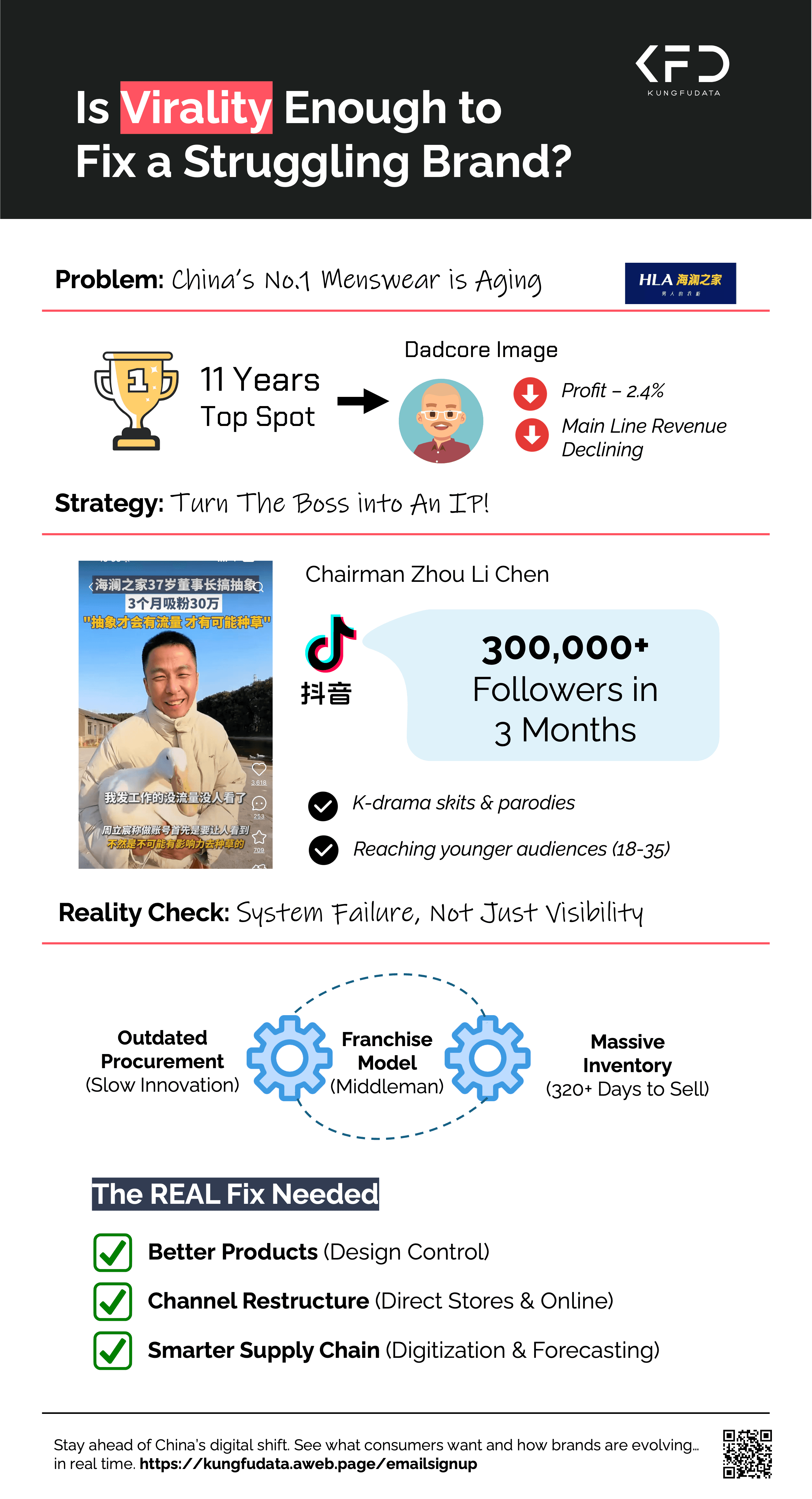
In just three months, Zhou’s account has gained more than 300,000 followers, with individual videos regularly pulling in hundreds of thousands of likes. A chairman personally acting in skits is not exactly traditional brand marketing, which raises a bigger question. Can short-video fame actually turn into a cure for a struggling business?
Why Does HLA Need the Boss to Step In?
On paper, HLA looks untouchable. Since 2014, it has held the top spot in Asia’s menswear market for 11 consecutive years. But behind the “national menswear champion” title, the cracks are obvious.
In the first three quarters of 2025, HLA reported revenue of RMB 15.6 billion, up just 2.2 percent year on year, while net profit actually fell by 2.4 percent. The core HLA brand is doing even worse. In 2024, its mainline revenue dropped over 7 percent, and by the first three quarters of 2025, revenue declined nearly another 4 percent.
The deeper issue is brand aging. That famous slogan, “Men only shop at HLA twice a year,” once made the brand a household name. But for younger consumers, HLA has quietly shifted from “every man’s wardrobe” to “dad’s wardrobe.” Even celebrity endorsements from trend-friendly stars haven’t fully shaken off the “dadcore” image.
At the same time, competition has intensified. Menswear overall has entered a zero-sum phase, while fast-fashion players like Uniqlo and UR have claimed younger consumers with clearer positioning and faster design cycles.
The Strategy. Turn the Boss into an IP.
Faced with these pressures, HLA chose one of the hottest prescriptions in China’s marketing playbook. Put the boss in front of the camera.
Zhou Lichen’s short-video content isn’t accidental. In pinned videos, he wears HLA coats while reenacting classic K-drama scenes or parodying popular “rebirth” mini-dramas. When questioned about the deliberately “abstract” style during livestreams, Zhou has been candid. Regular meetings and work updates don’t attract attention. They don’t influence buying decisions. They don’t go viral.
The results, at least on the surface, look promising. Zhou’s account crossed 300,000 followers in three months, and HLA says more than 60 percent of its online consumers are now between 18 and 35 years old. The message is clear. This approach is reaching younger audiences.

This Playbook Has Worked Before.
Zhou isn’t the first executive to try this route. The most famous example is Lei Jun, whose personal brand has become one of Xiaomi’s strongest marketing assets. With over 40 million Douyin followers, Lei’s account now functions as Xiaomi’s most direct communication channel, especially in its push into electric vehicles.
Another case is Dong Mingzhu of Gree Electric, who has spent years building influence through livestreaming. In 2025, her high-profile reunion livestream with former assistant Meng Yutong attracted nearly three million viewers and generated RMB 5 million in sales.
From Lei Jun to Dong Mingzhu to Zhou Lichen, Chinese executives are stepping out from behind corporate walls, using personal stories to replace generic advertising and build emotional connections with consumers.
The Reality Check. Can Traffic Fix the Numbers?
This is where things get uncomfortable.
Despite the surge in attention, traffic hasn’t translated into a turnaround in performance. Online buzz hasn’t reversed HLA’s offline slowdown. Revenue in the first three quarters of 2025 still declined nearly 4 percent year on year.
There’s also a positioning dilemma. Zhou openly admits that “abstract” content is necessary to attract attention, but does this playful, meme-driven persona dilute HLA’s long-standing image of reliability and professionalism. That tension shows up in products too. HLA’s push into outdoor apparel emphasizes lifestyle scenes more than hard technical specs like waterproof ratings or breathability, making its “youthful” repositioning feel superficial.
Then there’s the risk of personal IP itself. Binding a brand too tightly to a founder is a double-edged sword. The Wenheyou controversy is a cautionary tale, where a co-founder’s inappropriate behavior during a livestream quickly triggered backlash that spilled into store reviews and brand reputation.
The Real Problem Isn’t Visibility. It’s the System.
At best, the chairman’s short-video debut is a loud marketing campaign. It can spark attention, but it cannot cure structural issues.
Comment sections already reflect this skepticism. Many viewers admit the boss-led skits are entertaining, but without real changes to the products, the strategy feels more like hype than substance.
HLA’s deeper challenges lie in its system. Its procurement model relies heavily on supplier credit and returnable inventory, which weakens innovation incentives. The company doesn’t design or manufacture directly, while suppliers don’t face real market feedback. The result is slow product updates and “classic styles” that stay on shelves for a decade.
On the sales side, HLA’s franchise-heavy model centralizes operations but turns the company into little more than a clothing middleman. Inventory keeps piling up. In 2024, HLA’s ending inventory reached nearly RMB 120 billion, up over 28 percent year on year. Inventory turnover days climbed to more than 320 days, meaning one item takes almost 11 months to sell.
What Actually Needs to Change?
First, product has to come back to the center. HLA has started talking about “younger” and “more international” design, launching items like its Aurora down jackets with features such as water resistance and high-loft goose down. But reclaiming design control from suppliers and building a consumer-led product system will take time.
Second, channels need restructuring. Offline, HLA is increasing directly operated stores in malls and department stores while experimenting with new formats like “city outlets” with JD. Online, it still needs to turn viral content into sustained sales rather than one-off spikes.
Third, digital operations must support everything. With inventory turnover exceeding 300 days, smarter demand forecasting and supply-chain digitization are no longer optional. Capital tied up in stock is a structural drag the brand can’t ignore.
The Bottom Line.
When the boss steps in front of the camera, it’s both a sign of anxiety and a signal of change. Traffic can ignite attention, but it can’t bridge the gap between products, channels, supply chains, and real consumer needs.
For HLA, the chairman’s videos are just a window. Whether consumers actually walk through the door depends on what they see inside. Truly refreshed stores, competitive pricing, thoughtful service, and a brand rebuilt from the inside out. This isn’t a quick rescue. It’s a long rebuild, and no amount of short-video magic can replace that work.

