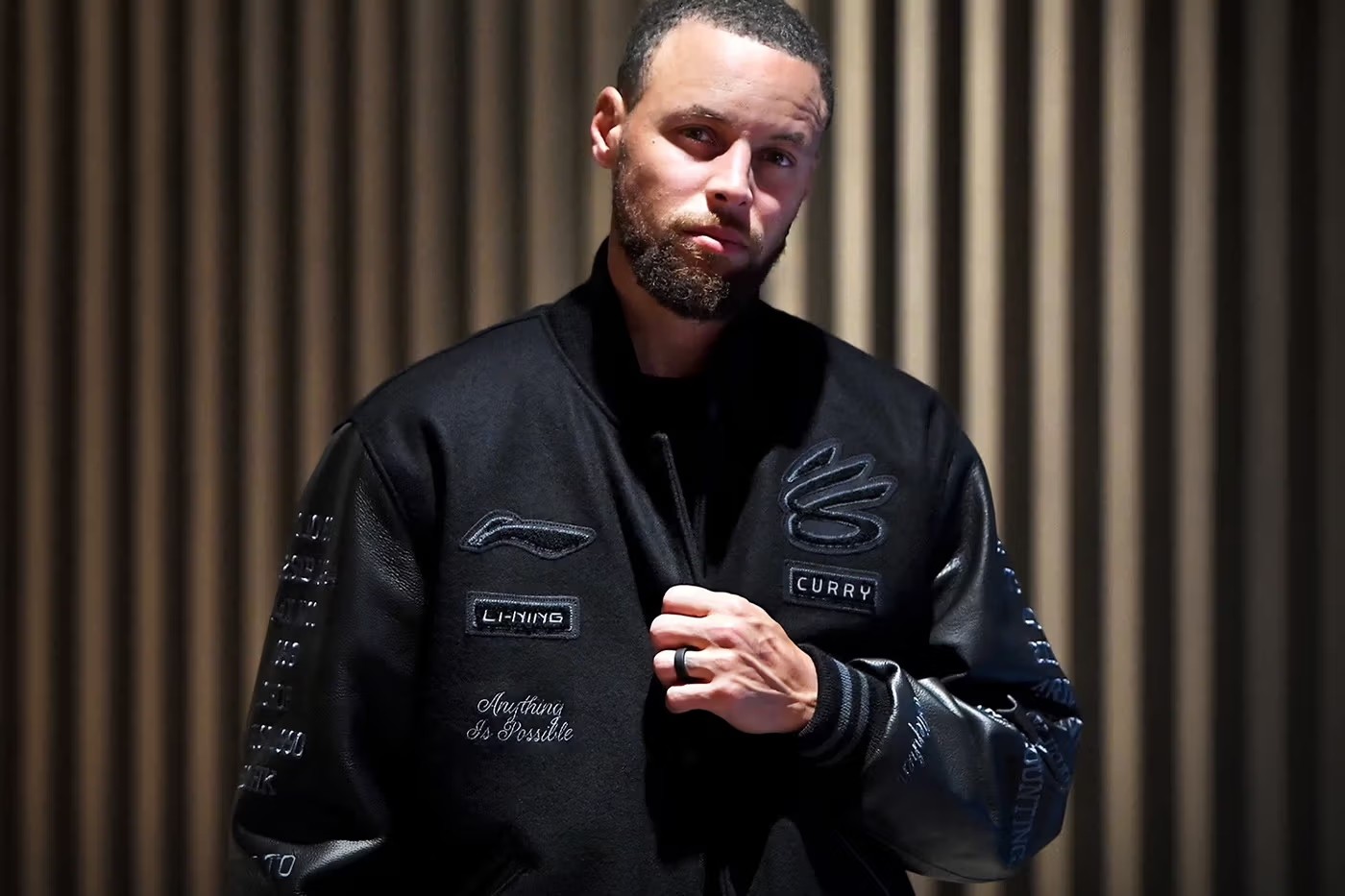
Li-Ning just signed Stephen Curry. The Curry Brand goes Chinese.
Stephen Curry just picked his next home. And it isn't an American brand.
On June 2, Li-Ning, the Chinese sportswear company founded in 1990 by Olympic gymnastics gold medalist Li Ning, announced a long-term partnership with NBA 4-time champion, 2-time regular-season MVP, and Olympic gold medalist Stephen Curry, plus his Curry Brand. Brand co-build. Multi-category product development. Basketball and golf as the starting line. Global expansion as the destination.
Call it what it actually is: the biggest cross-Pacific brand union in sportswear since LeBron signed with Nike, and it tells you exactly where the Chinese sportswear playbook is going next.
What just got signed
The June 2 announcement set out a partnership built on what Li-Ning called "brand co-build" (pin pai gong jian 品牌共建, "brand co-construction"). The scope:
Multi-category professional sports gear development
Sports culture promotion
Connection to the new generation of young athletes
Global expansion of both the Li-Ning brand and the Curry Brand
Starting points: basketball and golf. Future reach: multi-sport scenarios. Sports lifestyle is named as a third pillar.
Stephen Curry's own framing in the announcement: "I hope the Curry Brand can become a brand that deeply invests for the long term, drives growth in the sports field, and brings real impact to athletes globally." And: "What impressed me most about Li-Ning shoes is the quality, comfort, and performance. They helped me play with confidence on the court, and they convinced me Li-Ning can support the Curry Brand's pursuit of innovation and design."
Li Ning, the founder, returned the framing: "Li-Ning and Stephen Curry share the same understanding and pursuit of sports. This partnership shows our shared commitment to professionalism, innovation, and the new generation."
The signing came after months of rumored interest between Curry's team and Li-Ning following the structural changes inside Under Armour's basketball business through late 2025 and early 2026.
Why Li-Ning. Why now.
Li-Ning has 35 years of brand history in Chinese sportswear. It is one of the 4 dominant Chinese performance-sports brands (alongside Anta, Xtep, and 361 Degrees). It has the strongest basketball legacy of the 4 thanks to the Wade brand. And it is the only one that can credibly claim "founded by an Olympic gold medalist" parity with what Curry himself represents in basketball.
Li-Ning's basketball roster matters. Way of Wade, the Dwyane Wade signature line, has been in the Chinese sneaker culture spine for over a decade. Players like Jimmy Butler, CJ McCollum, and Caris LeVert wear Li-Ning. The brand has had top-tier NBA player endorsements before. What it never had... was a current-era top-3-globally-ranked NBA superstar.
Curry plugs that hole instantly.
For Curry himself, Li-Ning offers what Under Armour stopped delivering:
Manufacturing depth at a scale Under Armour couldn't compete with after its 2025 restructuring
China market access for the Curry Brand as a standalone proposition. Curry Brand has been a hard sell in China while owned by a US brand fighting Nike for store space. Under a Chinese partner the doors open.
Long-term equity-level co-build language. The official communication never used the word "endorsement."
Golf as a credible expansion category. Curry is genuinely passionate about golf. Li-Ning has been quietly building a Chinese golf-equipment presence. The categories line up.
For Li-Ning, this deal solves 3 specific problems:
The brand's basketball heat needed a refresh after FY25/26 numbers cooled. Curry is the most marketable basketball athlete on earth right now.
The brand's international ambition needed a credible non-Chinese face. Curry is universally known across Asia, North America, and Europe.
The brand's investor narrative needed a major signal in a year when traditional Chinese sportswear stocks have been beaten down.
What this tells you about the sportswear endorsement landscape
Pre-2026, the implicit deal in NBA-Chinese-brand crossover was: a B-tier NBA player would take Chinese-brand money because their Nike or Adidas contract was up. The Chinese brand got reflected glow. The player got cash. Neither side claimed it was central to global brand-building.
Curry blows that template apart. Look at the language:
"Brand co-build" (品牌共建)
"Global development of the Li-Ning brand and the Curry Brand"
"Long-term partnership"
Curry talking about being personally impressed by Li-Ning's R&D
Read it carefully: two sports companies, one American and one Chinese, deliberately fusing equity to attack global markets together, rather than a Chinese brand renting an NBA name. The Curry Brand gets Chinese manufacturing and Chinese consumer access. Li-Ning gets American basketball authenticity and a credible globalization narrative.
It is the most aggressive endorsement structure in sportswear since LeBron's lifetime deal with Nike. And the direction of travel is east to west.
What Western sportswear should learn from this
The Curry hire is the most ambitious sportswear cross-border move you'll see this year. Six things to take from it if you run a Western fashion, lifestyle, or sportswear brand thinking about China entry or scale:
Co-build trumps endorsement. The era of paying an athlete to wear a logo is over. Athletes now want equity, brand voice, and product-design input. Structure your deals accordingly or lose to brands that do.
China is no longer a "license out" market. It is a "merge in" market. Curry didn't license his name to Li-Ning. He merged his brand strategy with Li-Ning's. Western brands that still think of China as an outbound license deal are 3 years behind.
Pick your category dance partner. Curry brings basketball depth, golf credibility, and global lifestyle reach. The brand co-build only works because the categories actually fit. Don't sign a Western athlete who doesn't fit your Chinese category roadmap.
Watch the language in the announcement. Curry and Li used identical phrases about "the new generation of athletes," "innovation," and "global expansion." That language is rehearsed. It signals a deeper IP-and-equity structure underneath. Western brands signing Chinese athletes need to think about the language scaffolding too.
The Olympic-athlete-founder narrative matters. Li Ning the man (1984 Olympic gold) is the brand's founding equity. Curry signing with another Olympic gold medalist is a narrative the marketing team will print on every product for the next decade. If your founder story isn't athlete-led, find an asset-level founder narrative that translates.
Expect more. Curry is the headline. Anta has Klay Thompson, Kyrie Irving, Kai Sotto, and Vital Heynen. Li-Ning now has Curry. 361 Degrees has Aaron Gordon, Jamal Murray, and Spencer Dinwiddie. Xtep has Jeremy Lin and JR Smith. The next Chinese-sportswear-NBA superstar deal will be a top-30 player and it will land before Q4 2026.
The closing thought
Stephen Curry shooting 3-pointers in Li-Ning sneakers is going to be the iconic sportswear visual of the next 18 months. Not in Beaverton's locker room. In Hangzhou's.
If your brand strategy still assumes American athletes will only wear American brands, the Curry signing just deleted that assumption. The Curry Brand is going Chinese. So is the next one.
You either show up to play in this new game, or you watch it from the sideline with a 10-K full of slowing growth.
The 2026 Chinese sportswear story is being written by the people who built basketball. The pen just moved east.

