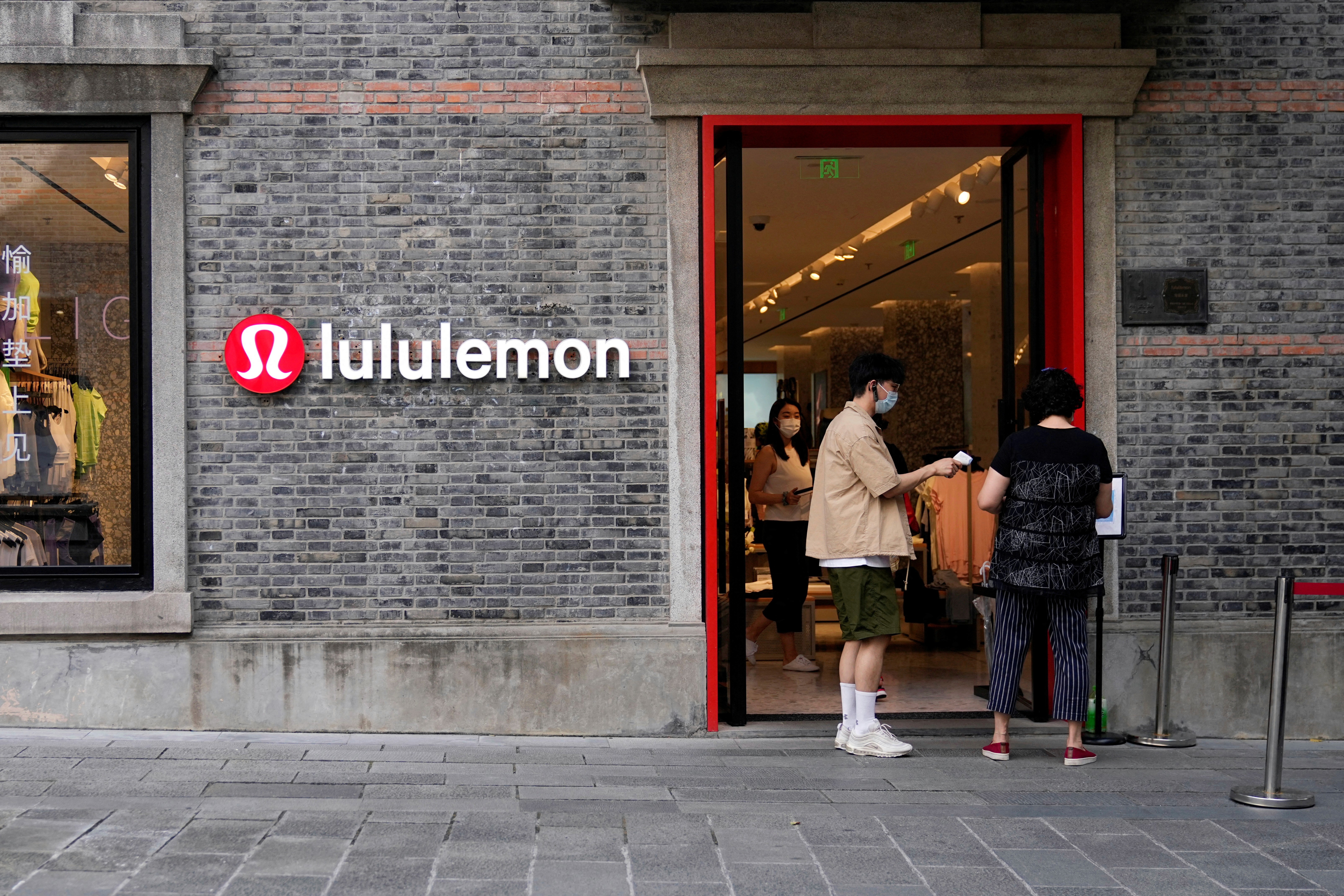
Lululemon's China just grew 30%. Its home market shrank 3%. The split is now official.
If Western brand owners needed one chart to understand 2026 China retail, Lululemon just printed it.
On June 4, the Vancouver-founded yoga-apparel giant reported Q1 FY26 numbers that look like 2 different companies stapled together. Mainland China net revenue up 30%, comparable sales up 20%, sustained leadership across women's and men's. Americas net revenue down 3%, comparable sales down 5%, full-year guidance just got cut.
Same brand. Same product. Two opposite stories. And the math behind that split tells you exactly where Western performance brands should be spending their next dollar.
The numbers
Q1 FY26 ended May 3, 2026. Headline numbers:
Total net revenue: $2,471,603 thousand, up 4% (up 2% constant dollar)
Net income: $195,048 thousand, down 38% from $314,572 thousand
Diluted EPS: $1.69 vs $2.60 in Q1 FY25
Gross margin: 54.2%, down 410 basis points
Operating margin: 11.2%, down 730 basis points
Operating income: $276.9 million, down 37%
Share repurchases: 2.2 million shares for $358.3 million
Regional split tells the story:
United States net revenue: down 4%
Canada net revenue: down 3% (down 6% constant dollar)
Americas net revenue: down 3% (down 4% constant dollar)
China Mainland net revenue: up 30% (up 23% constant dollar)
China Mainland comparable sales: up 20% (up 13% constant dollar)
Rest of World net revenue: up 13% (up 9% constant dollar)
International net revenue: up 22% (up 16% constant dollar)
Store fleet: 816 stores end of Q1, opened 11, closed 6 in the quarter.
Full-year FY26 guidance got cut. Net revenue now expected at $11.0 billion to $11.15 billion, a 1% decline to flat. Diluted EPS now $10.95 to $11.15, lowered from prior guidance.
What's actually breaking in the Americas
US net revenue dropped 4%. Canada dropped 3% (worse in constant dollar terms at -6%). Comparable sales in the Americas dropped 5% (-6% constant dollar). Gross margin compressed by 410 basis points. SG&A as a percent of revenue jumped from 39.8% to 42.9%.
Interim co-CEO Meghan Frank acknowledged the issue directly: "More recently, we have been navigating headwinds that have led us to adjust our outlook for the full year. We have assessed the business and are taking additional actions to reposition where needed and further strengthen our product engine."
Translation: the product pipeline is being rebuilt. Inventory management is being tightened. Pricing is being recalibrated. None of these fixes happen in one quarter.
The Americas problem has 4 layers:
Athleisure overdistribution. Vuori, Alo Yoga, Set Active, Bandier, Spanx Wear, plus Nike Universe, all crowded the same Lululemon premium-yoga shelf in tier-1 American malls. Lululemon has lost its category exclusivity in the US.
Tariff overhang. Forward guidance specifically excludes potential IEEPA tariff refunds and doesn't incorporate future tariffs. Margins will stay pressured through 2026.
Calvin McDonald exit. Calvin McDonald, the former CEO who ran Lululemon's golden decade, stepped down in March 2026. Frank and André Maestrini are interim co-CEOs. A permanent CEO is still being recruited. The brand is operating without a fully empowered top seat during its hardest year.
The "running" pivot has not fully landed. Lululemon's push into performance running (capsule activations referenced in the earnings press release) is being eaten by On Holding, Hoka, Brooks, Asics, Salomon, and Norda's wave. The Americas runner does not yet think Lululemon for running shoes.
Why China is the opposite picture
China Mainland net revenue +30%. Comparable sales +20%. Through ~170 mainland China stores trending toward a planned 220 by end of FY26. Through a wholly-owned direct retail model (no Chinese distributor). Through Tmall flagship plus Xiaohongshu plus WeChat mini-program plus Douyin store flagship as the digital stack.
Here's what's working:
The category is still wide open in China. "Athleisure" as a Western category translated into Chinese fitness culture in 2018-2020, hit its first wave through Lululemon, and then expanded in the past 2 years. Maia Active and Hosa Sportswear and Particle Fever and Pearl are local challengers but none of them has Lululemon's brand legacy. The category is uncrowded compared to the US.
The 35-45 high-income urban woman in tier-1 China is still spending on premium fitness apparel. The "rich auntie" segment that just collapsed Koradior is not the same segment that buys Lululemon Align tights. The Lululemon customer in China is younger, more education-focused, more aspirational-fitness-coded, and her wallet has been unlocked again by the ChiNext-driven wealth effect Q1 2026 brought back.
Direct retail means margin protection. Lululemon is one of the few Western brands operating a pure direct-to-consumer model in China. No distributors, no wholesale dilution, no margin leakage. When the China business grows 30% on the top line, most of that growth is dropping to brand contribution margin.
The store rollout is accelerating into white space. Lululemon is not opening in tier-3 cities. It's deepening density in tier-1 (Shanghai, Beijing) and tier-2 (Chengdu, Hangzhou, Shenzhen, Suzhou, Hangzhou-adjacent suburbs). Each new store opens above $1 million in first-year revenue on day one based on industry estimates. The unit economics are best-in-class.
Men's apparel is the next leg. Lululemon men's in China is small today but growing at about 2x the women's rate. Tier-1 Chinese male urban consumers in the 28-42 age band have started buying Lululemon for the same reasons their wives did 5 years ago.
What this tells YOU as a Western brand
If you run a Western performance brand, the Lululemon Q1 split is a freebie roadmap. Read it carefully.
Six things to do this quarter:
Stop assuming your home market growth tells you anything about China. A -3% Americas result and a +30% China result for the SAME brand SAME product SAME quarter is not noise. It is a structural divergence. Plan capital accordingly.
If you don't have a direct retail China presence, build one now. Lululemon's margin protection on its China growth depends on running every store and every digital channel directly. Distributor-led performance brands cannot replicate this. The catch is that direct China takes 5-7 years to build. Start now or accept the ceiling.
Density beats coverage. Lululemon is not opening 1 store in every Chinese capital city. It is opening 4 stores in Shanghai and 3 in Chengdu. Density compounds brand familiarity. Coverage dilutes brand control. Pick density.
Build the men's roadmap before you need it. Lululemon men's was a 4-year build inside China before it became a measurable contributor. Western performance brands trying to grow men's in China overnight will fail. Start the build now even if it doesn't pay off until 2028.
Don't expect to win running through brand alone. Lululemon is the most powerful athleisure brand on earth and is still being outflanked by Hoka, On, and Salomon in performance running, including in China. If your brand wants to play in running, you need actual specialist product depth, not a halo from another category.
CEO succession is risk. Calvin McDonald's departure cost Lululemon execution speed for at least 12 months. If your brand is going through CEO turnover, your China investment plans should be re-underwritten before the new permanent CEO is named.
The closing thought
The Western performance-brand industry just got told its 2026 truth: Americas is the cost center. China is the growth center.
Lululemon's 30% China revenue lift is the bailout for a 3% Americas decline. Without China, the Q1 numbers and the full-year guidance would look much, much worse.
You either get serious about a direct, premium, density-led China retail build... or you watch your brand become a $40 stock with the wrong half of the world growing.
The math is on the table. Read it.

