China Just Publicly Roasted a Brand for a Mother's Day Ad. Western Brands, Take Notes.
On May 8, 2026, OPPO posted a Mother's Day campaign with this line: "My mom has two 'husbands.' One is my dad. The other she sees twice a year. She barely dresses up for dad. For the other one, she wants to wear a wedding dress."
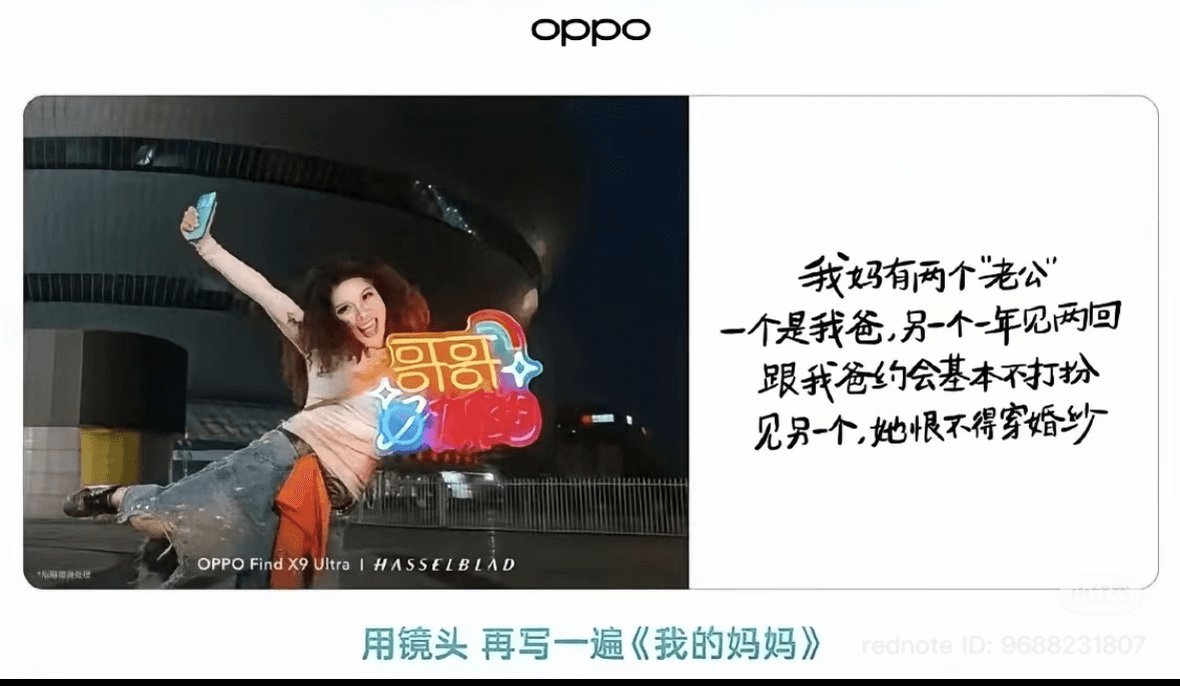
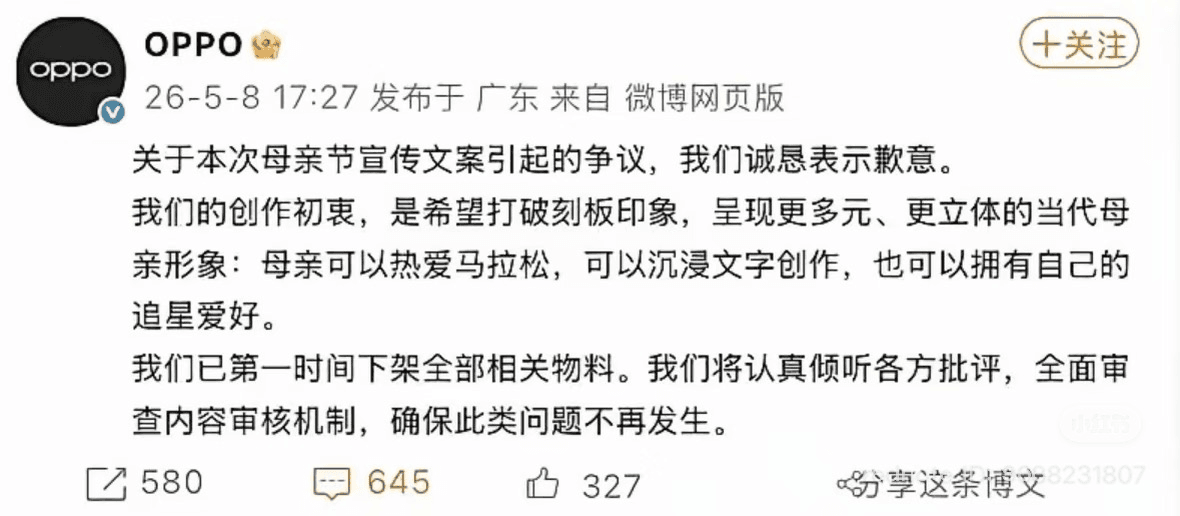
By that evening, OPPO had pulled the campaign and issued a public apology.
By May 10, the China Advertising Association had published a formal statement calling for the entire industry to "resolutely resist marketing that distorts family affection, mocks families, and uses vulgar meme-play." Wuhan University - whose alumnus reportedly led the creative team - released its own statement saying the content "seriously contradicts the university's values of moral education."
Then OPPO dropped the internal hammer.
The company classified the incident as a "major brand accident" (重大品牌事故) under its corporate accountability policy. Four executives were punished:
Duan Yaohui, Head of China Business: Demoted two full levels. Annual performance capped at C (the lowest passing grade). Pay frozen for 36 months. Three years. For one Mother's Day post.
Wang Yi, Direct Business Unit Director: Demoted one level. Performance capped at C. Pay frozen for 12 months. Cited for "failing to effectively fulfill review and gatekeeping responsibilities."
Ma Xin, Head of PR: Performance capped at C. Pay frozen for 12 months.
Project Team Lead: Demoted one level. Performance capped at C.
Read that list again. The head of OPPO's entire China business got demoted twice and pay-frozen for three years because of one piece of holiday marketing copy. That's not a slap on the wrist. That's a career-altering consequence for a social media post that was live for less than 12 hours.
If you're a brand owner running campaigns in China and you think tone-of-voice risk is a "soft" issue... OPPO just showed you exactly how hard it hits.
What the Campaign Actually Said
OPPO's Mother's Day creative was written from a child's perspective. The full copy described a mother who has interests beyond family - marathons, writing, celebrity fandom. The creative intent, per OPPO's own apology, was to "break stereotypes and present a more diverse, multi-dimensional image of contemporary mothers."
That's a defensible creative brief. It's also exactly the kind of brief that kills brands in China when the execution slips.
The execution slipped. Hard.
Using the word "husband" (老公, lao gong) to describe a celebrity crush. Framing it from the kid's perspective. Comparing the crush to dad. Making mom look like she preferred a fantasy over her actual marriage. On Mother's Day.
The reaction was instant. Weibo trending hashtags about "OPPO copy values" (OPPO文案价值观) went viral within hours. Users called it disrespectful to women, disrespectful to families, disrespectful to the entire concept of maternal love. The Paper described it as "meme-play without warmth" (玩梗失度,营销失温).
OPPO apologized that same evening, stating they had "immediately removed all related materials" and would "thoroughly review content review mechanisms." But the apology backfired. Users read OPPO's explanation - "we wanted to break stereotypes" - as the brand defending its bad creative rather than actually apologizing. The user mood, captured across Chinese media: "OPPO isn't apologizing. OPPO is justifying."
Then the institutional responses stacked up. The China Advertising Association warned the entire industry that advertising is "an important window for cultural communication and value transmission, absolutely not a playground for vulgar meme-play, sensational speculation, or traffic stunts." Wuhan University's literature department released a separate statement distancing itself from the alumnus who led the creative, saying the content was "seriously inconsistent with the university's educational philosophy."
OPPO's own internal notice acknowledged what everyone already knew: the incident "caused great harm to the public, users, and employees," triggered "large-scale negative public opinion," and "seriously damaged brand reputation."
When your alma mater publicly disowns your ad copy and your company demotes your China head twice... the campaign has officially transcended marketing failure.
Why This Keeps Happening, Every Single Year
OPPO is not the first. The pattern repeats with clockwork regularity.
Blue Moon (蓝月亮), 2024. The detergent brand ran a Mother's Day elevator campaign with the slogan "Mom, you use it first" (妈妈,您先用), reinforcing the stereotype that laundry is exclusively a mother's job. The backlash was so severe that Blue Moon launched a public contest to crowdsource a new slogan, offering 100,000 RMB prizes to winners. The contest itself got mocked as a tone-deaf PR move.
Bobbi Brown, Coconut Palm Juice (椰树), Mengniu, Procter & Gamble China... the list of brands that have had campaigns shredded by Chinese consumers gets a new addition almost every year. The specifics change. The pattern doesn't.
A brand assumes that the irreverent, ironic, or "edgy" tone that plays well in Western or Korean creative will translate to China. Then they ship it. Then Chinese consumers - who have been absorbing brand messages for 25 years and have developed the sharpest content-radar on the planet - take about 6 hours to identify what feels wrong.
What feels wrong in 2026 China:
Copy that pits family members against each other for laughs
"Jokes" about gender roles, marriage, or maternal duty
Western "anti-mom" or "edgy mom" memes that don't survive cultural translation
Celebrity-crush content layered onto family relationships
Brands using Gen-Z slang in contexts where the audience expects warmth, not cleverness
Chinese women on Xiaohongshu and Weibo have built a public feedback loop that can dismantle a campaign before the brand's PR team finishes its morning coffee. The China Advertising Association response time was 48 hours. The user response time was 48 minutes.
Why Fashion Brands Should Be Reading This Closely
You might be thinking: "I'm a fashion brand. This is about a phone company and a detergent brand. Not my problem."
Wrong. This is especially your problem.
Mother's Day is one of the highest-stakes marketing windows in fashion. In 2026, Tiffany ran "Celebrating Mothers Since 1837." Dior built a full "Art of Gifting" moment around J'adore Eau de Parfum with limited-edition butterfly boxes. Louis Vuitton released a curated gift edit of leather goods and fragrances. Estée Lauder centered the holiday around Advanced Night Repair gift sets. Swarovski launched a "Gift of Light" capsule.
Every one of these brands operates in China. Every one runs Mother's Day creative through Chinese channels. And every one is one campaign brief away from being OPPO.
The cultural lines you cannot cross in Chinese Mother's Day marketing:
Family ethics (家庭伦理, jia ting lun li): Do not pit family members against each other in copy. Not even ironically. Not even as a joke.
Marriage relationships (婚姻关系, hun yin guan xi): Do not "joke" about boundaries between spouses. The OPPO campaign died on this hill.
Maternal love (母爱, mu ai): Do not reframe it as transactional, ironic, or anything other than reverent. Chinese consumers expect warmth here, not wit.
Public morality (公序良俗, gong xu liang su): This is the legal term Chinese regulators use. Cross this line and your campaign doesn't just get criticized. It gets pulled. Sometimes by force.
The Cost That Doesn't Show Up in the Media Budget
A pulled campaign costs more than wasted creative spend. OPPO just proved it costs careers.
The company had been investing heavily in positioning its Find X series for the women's market - colorways designed to attract female premium buyers, marketing built around women's lifestyle moments. Chinese media pointed out the irony: the brand spent months building goodwill with its most valuable consumer cohort, then torched it in one Mother's Day post.
But the internal punishment notice reveals a deeper cost. OPPO's own language - "caused great harm to the public, users, and employees" - tells you the damage wasn't just external. Internal morale took a hit. The employees who had nothing to do with the campaign still had to answer for it. The China business head who probably didn't personally write or approve the copy still got demoted twice.
That's the part Western brand owners miss. In Chinese corporate culture, brand accidents don't just cost the person who made the mistake. They cost the person at the top of the chain. OPPO's accountability structure made that explicit: the China head bears "ultimate management responsibility" (最终管理责任). The business unit director bears "direct management responsibility" for "failing to effectively fulfill review and gatekeeping duties."
For any brand building a China consumer base, a single holiday misstep can trigger:
Public criticism from official advertising regulators (these statements live in search results for years)
Xiaohongshu and Weibo trending hashtags dedicated to mocking your brand
KOL disengagement when influencers see your campaign tagged as "low-brow"
Consumer boycott calls on a holiday weekend when emotions run hot
Permanent trust damage with women aged 25-45, the single highest-value buyer cohort in Chinese fashion
Internal career consequences that ripple far beyond the marketing team
And the "out of context" defense doesn't work. OPPO tried it. Consumers read the explanation as the brand lecturing them about why their reaction was wrong. That made it worse.
What You Should Do Before Your Next China Holiday Campaign
Add at least 2 China-resident reviewers who are NOT on the marketing team. Customer service. Finance. HR. People who don't have skin in the campaign's success. They'll catch what your creative team is too invested to see. OPPO's own punishment notice cited "gaps in specific business review mechanisms." Translation: nobody outside the project team looked at this before it went live.
Never approve copy that "jokes" about family relationships, gender roles, or maternal duty. Even when the joke lands in your home market. Especially when it lands in your home market. China is not your home market.
Read the copy out loud in Mandarin to a Chinese woman aged 25-45. If she winces, pull it. Don't "iterate." Pull it.
Track China Advertising Association statements monthly. When they speak publicly about a brand campaign, the message is also a warning for the rest of the industry. You don't want to be the brand they name next.
Match Mother's Day creative to Chinese maternal sentiment, not ironic detachment. Reverent. Warm. Specific. The Chinese consumer doesn't need clever subversion of the holiday. She needs you to show up with respect.
Pre-test your campaign on a Xiaohongshu micro-panel before launch. Spend ¥10,000 to test with 50 women. Save ¥5 million on a pulled campaign and a permanent brand-trust dent.
Build internal accountability before you need it. OPPO had a "Brand Accident Accountability System" (品牌事故问责制度) already in place. When the crisis hit, they had a structure to respond with. If your China operation doesn't have a documented review process with named approvers, you're flying blind.
OPPO's campaign was approved by people who thought it was clever. Then 48 minutes of Weibo told them otherwise. The China Advertising Association told them louder. Wuhan University told them loudest. And OPPO's internal punishment notice made it permanent - four careers altered, one of them for three years, over a social media post that was live for half a day.
Hire a Chinese mom to read your Mother's Day creative before it ships. She'll tell you in 60 seconds what your global creative team missed in 6 weeks. It's cheaper than a 36-month pay freeze.