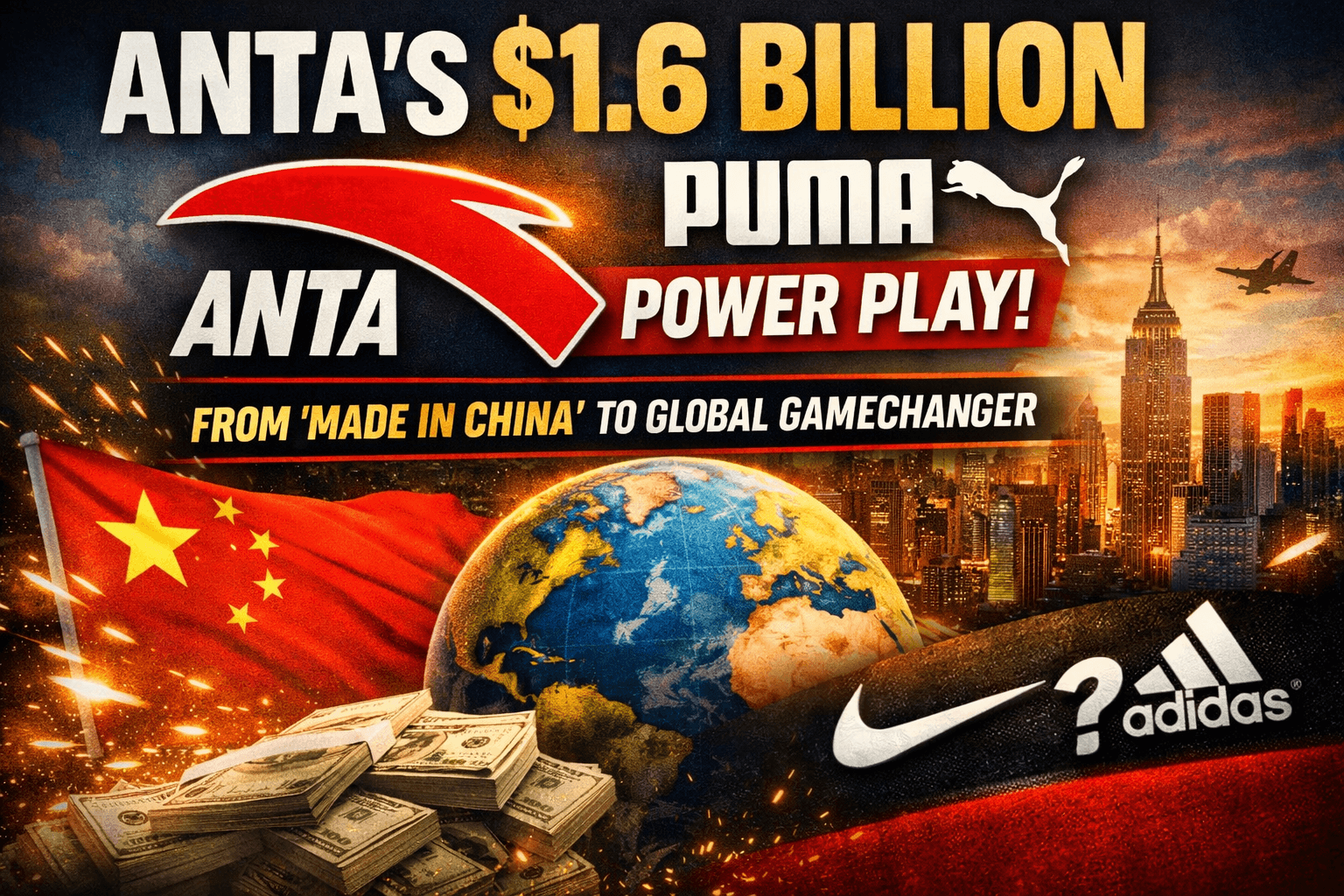
The New World Order: Why Anta’s $1.6 Billion PUMA Bet is the End of "China-Only" Strategy
In the high-stakes world of global sportswear, 2026 will be remembered as the year the "Big Cat" found a new master - and the year the old playbook for Chinese capital was set on fire.
On the morning of January 27, the rumors that had been simmering since 2018 finally boiled over. Anta Sports, the undisputed king of Chinese sportswear, announced a €1.506 billion (approx. RMB 12.2 billion) cash deal to acquire a 29.06% stake in PUMA. By buying out the Pinault family’s Artémis group, Anta didn't just become PUMA’s largest shareholder; it signaled that China is done playing defense in its own backyard.
This is a move about global credibility, not domestic expansion. For every global brand executive watching from the sidelines, this is a masterclass in the new reality of retail power.
The Deal by the Numbers: A 60% Premium on "Potential"
Anta’s bid of €35 per share represents a massive 60% premium over PUMA's market price. On paper, it looks like a gamble. PUMA has been navigating a brutal rough patch, posting a net loss of €247 million in the first half of 2025.
But Anta isn't looking at the quarterly loss; they are looking at a 75-year-old global icon sitting at a discount.
Metric | The Anta-PUMA Snapshot |
Total Cash Outlay | €1.506 Billion (RMB 12.2 Billion) |
Stake Acquired | 29.06% (Single Largest Shareholder) |
Premium Paid | ~60% above market price |
2024 Global Revenue (Combined Effect) | ~$25 Billion (Approaching Adidas’ $26.7B) |
The funding is coming entirely from Anta’s internal reserves - no external debt required. With over RMB 55.5 billion in cash and equivalents as of mid-2025, Anta is effectively using its domestic "war chest" to buy its way onto the global stage.
The Death of the "FILA Playbook"
For a decade, Anta mastered a specific formula: Buy an international brand, localize it hard, and scale it via China’s massive middle class. It worked with FILA, which became a high-end growth engine under Anta’s wing. It worked with Descente, Salomon, and Arc’teryx. These were brands that were "under-developed" in China. Anta provided the manufacturing, the retail footprint, and the supply chain muscle to make them dominant locally.
But PUMA is different. PUMA isn't a niche outdoor label waiting for a China turnaround. It’s a direct competitor to Anta with deep global roots.
Anta is not buying PUMA to "fix" China. They are buying PUMA to fix Anta’s biggest weakness: International Relevance. Despite its massive revenue, Anta is still overwhelmingly a domestic giant. As of 2025, only a fraction of its 13,000 stores were outside China. PUMA is the ticket to distribution networks in Europe, Latin America, Africa, and India.
The Strategy: "Gentle and Certain" Influence
In the 12-page Hong Kong Stock Exchange announcement, Anta made one thing clear: they aren't planning a hostile takeover. They are seeking a seat on the Supervisory Board, respecting PUMA’s German management and its independent governance.
However, a complex "Extra Payment" mechanism (valid for 15 months post-transfer) reveals the real game. This clause protects the sellers if Anta decides to launch a full takeover bid or if a third party enters the fray. It’s a "strategic minority" play - influence without full integration.
Anta is betting that it can inject its operational DNA into PUMA’s global network without erasing the brand’s soul. They’ve done it before: it took five years for FILA China to turn around, and five years for Amer Sports to reach full-year profitability. Anta has the one thing Western public markets often lack: Strategic Patience.
Why Global Brands Should Be Paying Attention
For brands eyeing China or watching their market share erode, the Anta-PUMA deal offers three urgent insights:
1. Credibility is the New Currency
Chinese capital is no longer just shopping for assets it can “China-ize.” It is shopping for global legitimacy. If your brand has heritage but slow momentum, the new question is not "Can they help us sell in Shanghai?" but "Can they help us stay relevant in London and Mumbai?"
2. The Rise of the "Hybrid Giant"
The competitive landscape has tilted. Nike and Adidas are no longer just competing with Western challengers like Lululemon or On. They are competing with Hybrid Giants—firms that combine Chinese supply chain speed and capital with Western brand portfolios.
3. Strategic Minority is the New Control
Anta does not need 100% of PUMA to shape the industry. By becoming the largest shareholder, they have secured "Optionality." They now have a seat at the same table as the world's elite brands, not as a regional heavyweight, but as a power broker in a global icon.
The Bigger Picture
This deal is not about PUMA’s next season; it’s about Anta’s next decade.
By the end of 2026, when the deal is expected to close, the "Anta-verse" will influence roughly $25 billion in annual revenue. This puts them within striking distance of Adidas for the global #2 spot.
For brands watching from the sidelines, the message is blunt: The era of China as a mere "market" is over. The era of China as a Capital Allocator and Strategic Power Broker has arrived. Anta didn't just buy a shoe company; it bought the future of the global sportswear hierarchy.

