H&M Is Closing 160 Stores and Only Opening 80. Is "Fast Fashion" Finally Admitting That Speed Kills?
Closing twice as many stores as you open isn't a retreat. It's a confession.
H&M just dropped its latest earnings report, and the numbers tell a story the brand would rather spin as "strategic transformation." In 2026, the Swedish fast fashion giant plans to open about 80 new stores... and shut down roughly 160. That's a net loss of 80 stores in a single year. For a brand that built its empire on rapid expansion and even faster product cycles, this is the equivalent of pulling the emergency brake at full speed.
But here's the thing... H&M isn't the only one doing this. ZARA, Uniqlo, and even China's own UR are all slowing down. Fast fashion is entering a new era, and the old playbook - open more stores, launch more SKUs, win more cities - is officially dead.
So what's actually going on?
The China Retreat is Already Happening
In 2025 alone, H&M closed 152 stores globally, with 105 of those concentrated in Asia, Oceania, and Africa. The H&M brand itself accounted for 117 of those closures.
In China specifically, the picture is brutal:
Nanjing: H&M's first-ever Nanjing store at Shuiyoucheng is reportedly closing. That would make it the 10th Nanjing store to shut down - meaning H&M would completely exit the Nanjing market.
Hong Kong: H&M's largest flagship store in Asia, located in Causeway Bay, officially closed on February 21, 2026.
The pattern is clear: H&M is pulling out of high-rent, underperforming locations across China. And they're not being subtle about it.
But Wait... They're Also Building a 5-Story "Style Mansion"?
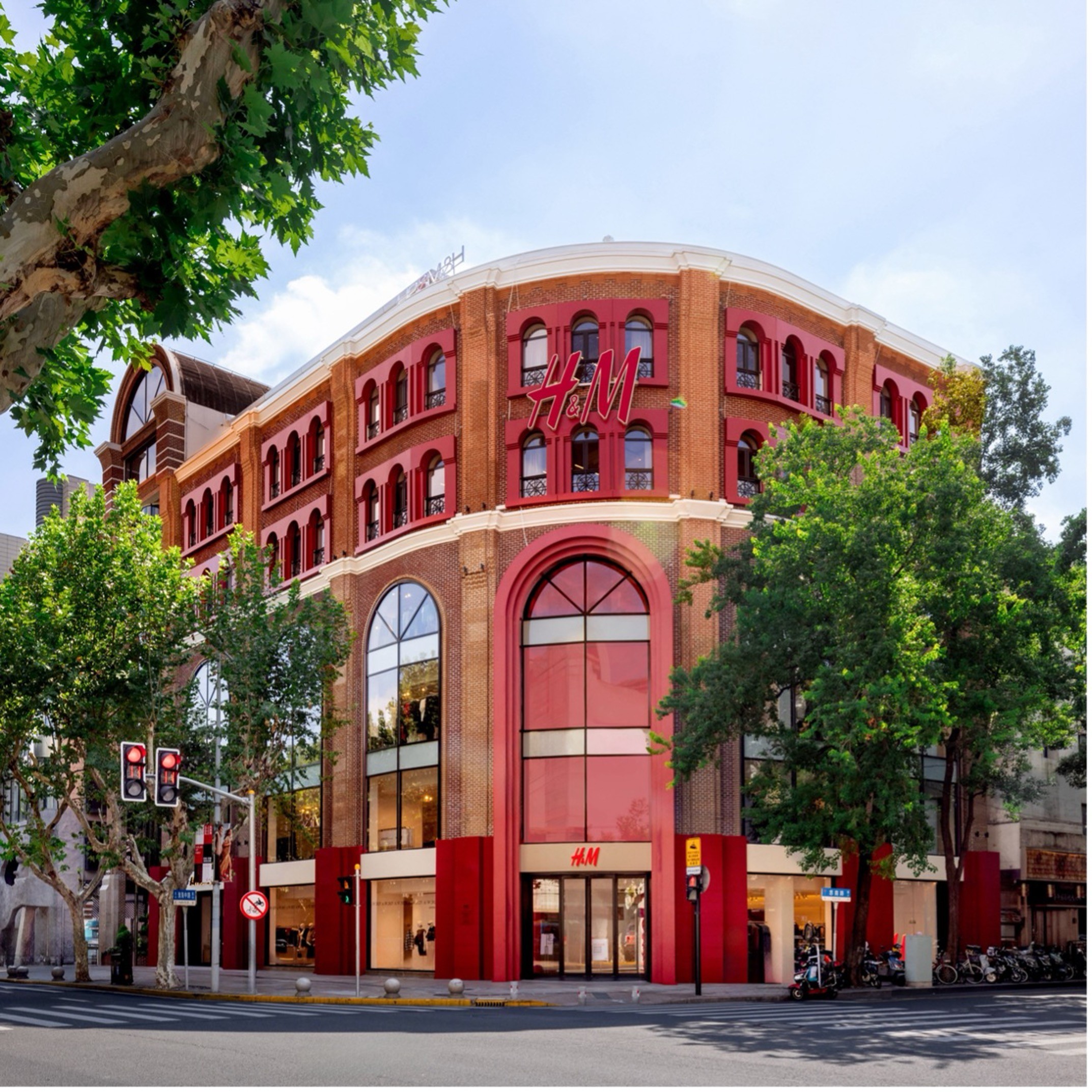
Here's where it gets interesting. While H&M is closing stores left and right, they opened something called "HOUSE OF H&M" (H&M Feng Ge Zhi Di) on Huaihe Road in Shanghai. This thing is roughly 3,000 square meters across five floors, and it's not just a clothing store.
It includes:
H&M HOME concept store
H&M&Cafe (yes, a cafe)
H&M flower shop
H&M&SPACE exhibition area
H&M Greater China's retail headquarters (on the upper floors)
Retail, content, social, and corporate HQ - all under one roof. This isn't a store. It's a brand temple. And it signals exactly where H&M thinks the future is: fewer locations, bigger bets.
Why H&M Hit the Brakes: 3 Reasons
1. The Discount Death Spiral
H&M runs major sales in June-July (summer), December-January (winter), plus spring and fall clearances in March and September. Discounts go as deep as 70% off. When you're slashing prices that aggressively, that often, you're training customers to never pay full price. And when you're also running hundreds of stores with high inventory... the math stops working.
2. Stores That Nobody Visits
E-commerce changed everything. Post-COVID, Chinese consumers don't just want to "buy clothes" - they want experiences. Many of H&M's older stores were built for a different era: wrong locations, cramped layouts, outdated interiors. They can't compete with the kind of experiential retail that consumers now expect.
3. They Ignored the Platforms That Matter
In China, consumers discover and buy on Douyin, Xiaohongshu, and multiple e-commerce platforms - often comparing prices across all of them before purchasing. H&M was too dependent on physical retail and too slow to build a real presence on the platforms where Chinese consumers actually spend their time.
It's Not Just H&M - The Entire Industry is Slowing Down
Brand | What They're Doing | The Strategy |
|---|---|---|
ZARA | Closed 10+ stores in China in the past year (Shanghai, Changsha, etc.) | Fewer stores, bigger flagship locations. Cut the underperformers, double down on high-potential locations. |
Uniqlo | Shifting to "mega-store" and "global flagship" model | Landmark stores that act as brand billboards, not just retail points. |
UR | Repositioned as "fast luxury" (Kuai She Shi Shang) since 2015 | Maintain fast product cycles but push toward premium quality, design, and distinctive store experiences. |
Every single one of these brands is making the same bet: fewer stores, higher quality, better experiences. The era of "open 200 stores a year and figure it out later" is over.
The 4 Challenges Nobody's Talking About
Closing stores sounds clean on a strategy slide. In reality, it's messy.
1. People Lose Jobs
160 store closures means thousands of employees facing reassignment or layoffs. How H&M handles this will be watched closely - and if they fumble it, the PR damage could be worse than the store closures themselves.
2. You Disappear From the Map
Closing underperforming stores improves your financials. But it also means entire cities lose access to your brand. When H&M exits Nanjing entirely, that's not just a store closing - that's a signal to consumers that you're retreating.
3. Your Team Doesn't Know What "Good" Looks Like Anymore
For years, the KPI was simple: open more stores. Now the KPI is... what exactly? "Quality"? "Experience scores"? Shifting an entire organization's mindset from growth-at-all-costs to quality-over-quantity is one of the hardest cultural changes a company can make.
4. The Brand Loyalty Trap
This is the big one. H&M's entire value proposition has always been "trendy clothes at low prices." That's baked into how consumers see them. Now H&M wants to build emotional connections through upgraded stores, designer collaborations (like their recent collection with Chinese designer brand JACQUES WEI featuring Lunar New Year and Year of the Horse elements), and premium experiences.
But here's the problem: if you raise prices to fund the upgrades, you lose the price-sensitive customers who made you successful. If you don't raise prices, you can't afford the upgrades. It's a trap with no easy exit.
The 2026 Fast Fashion Survival Checklist
If you're a fast fashion brand operating in China right now, here's what you need to figure out:
Store Math: Is every single store profitable, or are you keeping some open just for "presence"? Presence without profit is a slow bleed.
Platform Strategy: Are you actually selling on Douyin and Xiaohongshu, or just posting content nobody engages with?
Experience Audit: Would a 25-year-old in Shanghai choose your store over a coffee shop? If not, why would they walk in?
Localization Depth: Do you have Chinese designer collabs, locally relevant campaigns, and products that feel made for China - not just translated into Chinese?
Price-Value Balance: Can you upgrade the experience without pricing out the customers who actually buy from you?
What This Means for Global Brands Watching From the Outside
H&M's retreat isn't just a fast fashion story. It's a preview of what happens to any global brand that enters China with a volume-first strategy and doesn't adapt.
The brands that will win in China in 2026 aren't the ones with the most stores. They're the ones with the smartest stores, the deepest platform presence, and the ability to make Chinese consumers feel like the brand was built for them.
If your China strategy still starts with "How many stores can we open?" - you're already two years behind.

