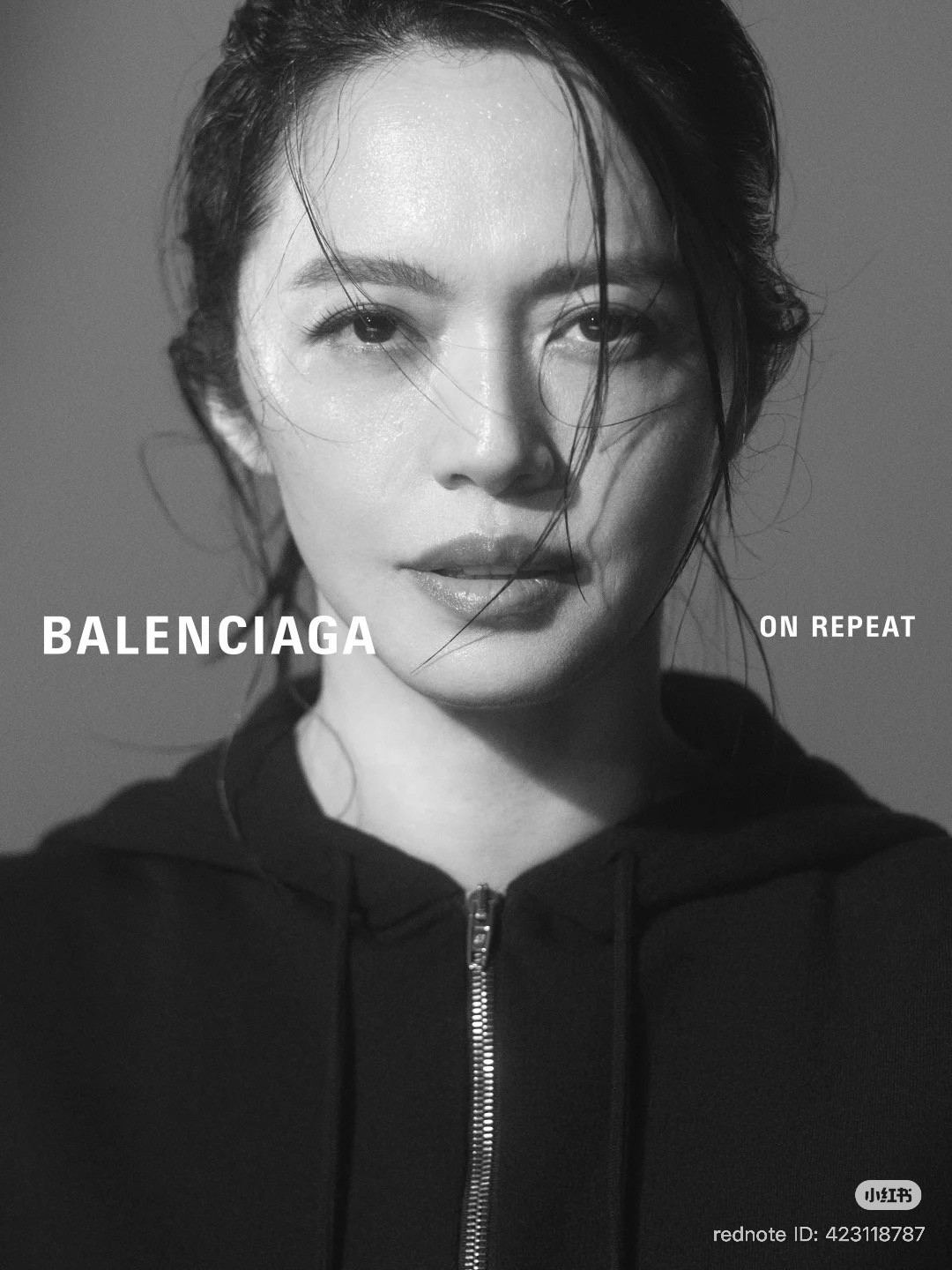
Balenciaga Misspelled Its Own Name in a Global Campaign. Chinese Internet Has Not Recovered.
BALENCAIGA.
Look at it again. BALEN-CAI-GA.
That's the word that showed up on the cover of a global Balenciaga sneaker campaign this week, featuring Chinese actress Yao Chen (姚晨) alongside Katy Perry. The real word, the one that's been stamped on handbags selling for $5,000 each for decades, is BALENCIAGA.
One transposed "I" and "A." Millions of impressions. Chinese internet went feral.
The Setup
Balenciaga dropped what should have been a huge China PR win. Yao Chen, one of the most influential mainland actresses with 96 million Weibo followers, got cast in a global sneaker campaign, standing next to Katy Perry. No warning, no preview. Just "surprise, a Chinese actress is the face of our global ad." The Chinese film community celebrated. Yao Chen reposted the news. Everyone was happy.
Then the campaign went live.
On official platforms, in major push copy, the brand name read: "BALENCAIGA." Eagle-eyed Chinese netizens zoomed in on the hero image. The misspelling was huge. Bold. Center of the layout.
By April 22, the news had exploded across Weibo, Xiaohongshu (Rednote), and WeChat. Chinese netizens renamed the brand "Bāli Càijiā" (巴黎蔡家), which translates as "The Cai Family of Paris." Cai is a common Chinese family name. So now the French luxury house had been involuntarily rebranded as "some random family in Paris."
The memes were ruthless. Screenshots of knockoff bags on Taobao actually spelled "BALENCAIGA" correctly as a fake. Chinese netizens joked: "Now the official version matches the fake. Finally, consistency." One Weibo user wrote: "Balenciaga just certified its own counterfeits as genuine."
L'Oréal Joined the Club in the Same Week
And then, because brand bloopers apparently come in packs, L'Oréal (欧莱雅, Ouláiyǎ) dropped a summer internship recruitment poster on the same platforms... with the brand name misspelled as "欧菜雅" (Oucáiyǎ).
Cài (菜) means vegetable. So L'Oréal recruiting in China looked like "Vegetable-yǎ," an open spot for cabbage-beauty interns. Worse, L'Oréal has done this exact same typo before. In a 2024 campaign. It's the second time.
Proya (珀莱雅), a major Chinese beauty brand, got caught in the crossfire too. Netizens dragged them in just for sharing the "lai-to-cai" sound-alike vibe.
For a few days in April 2026, Chinese beauty and fashion Weibo basically became a typo museum.
This Is Not a Joke Story. This Is a QA Story.
Here's why you should care, even though it looks like light entertainment. These typos weren't made by some junior translator. Balenciaga's global brand guardrails are supposed to prevent exactly this. A layered approval process runs through New York, Paris, and regional teams. For a Chinese-language campaign featuring a Chinese actress with global distribution, that approval chain should have included at least one Chinese-fluent senior manager looking at every single asset.
Somewhere, that chain broke.
The leading theory from insiders: the creative was built in Paris, signed off in English, passed to Chinese partners for push distribution, and nobody did a final visual check on the final rendered artwork. Automated design tools and template-based content have accelerated the production pipeline... but also introduced a new class of error: the "render-time typo," where copy gets substituted by a template variable, an autocorrect quirk, or a character swap that doesn't show up in the staging environment.
Or maybe even simpler. Someone copy-pasted the brand name wrong. Nobody caught it.
The Chinese famous fashion author wrote a column this week pointing out the deeper pattern: "These typos are not random mistakes. They're a signal that the China team has been under-resourced or hollowed out. When brands rotate Chinese marketing leaders every 18 months, when headcount gets cut because China growth is 'stalled,' typos happen. And once typos happen, trust erodes. Trust is easier to lose than regain."
The Real Cost: Chinese Consumer Trust
Luxury brands in China are already under pressure. Kering's Asia-Pacific retail revenue fell 4% in Q1 2026. Many European luxury houses are reporting "single-digit growth at best" in China. The ones winning (Hermès +2% Asia, Brunello Cucinelli +14% China) are the ones with strong operational discipline.
In this context, a typo that turns your brand into a national meme is not just embarrassing. It's operational proof that your China care factor has slipped. Chinese consumers are increasingly demanding. They expect premium brands to show up premium. A sloppy campaign suggests sloppy product. Sloppy product means: maybe that 32,000 yuan handbag is also half-heartedly made.
That's the narrative you do not want gaining traction.
Yao Chen, to her credit, handled it gracefully. She didn't mention the typo directly. She just reposted the campaign images and smiled. The brand itself has stayed quiet, hoping the internet forgets. It won't, entirely. But the news cycle will move on.
What won't move on: the underlying perception that Western luxury brands have stopped paying attention to China.
What YOU Should Take Away
If you're a Western brand building in China, this is your checklist:
Never publish Chinese-market creative without a native Chinese speaker approving final assets. Not translating. Approving. At a senior level. That approval should happen after final rendering, not before.
Build a typo-catch protocol. Your brand name. Your key product names. Your tagline. Every Chinese-language push asset should be reviewed with those specific words flagged in bold. Yes, that's slow. Yes, that adds a day. Yes, it's worth it.
Watch for "template variable" errors. Automated design tools, AI-assisted layout generators, and template-based production increase the risk of substitution errors. Your QA process should include a final human rendered check, not just a staging check.
The cost of a typo in China is not "some Weibo chatter." It's a meme you can't delete, a perception that you've stopped caring, and a counterfeit-vs-genuine joke that becomes branded shorthand. In a market where consumer trust takes years to build, you can lose it in an afternoon.
If your China team is shrinking, your typo risk is growing. Correlate your operational quality directly to your local team size and seniority. When brands cut China marketing staff, typo scandals follow within a quarter.
Balenciaga will survive BALENCAIGA. It has enough brand equity to absorb a few memes. But the market wasn't watching Balenciaga this week. It was watching how a global luxury house treats a campaign built specifically to celebrate a Chinese talent... and finding the answer to be "a rush job with spellcheck off."
That answer is on the record now. Permanent. Searchable.
Type "BALENCAIGA" into Baidu. Rows of laughter still scrolling. That's what you're really buying when you skip China QA.

