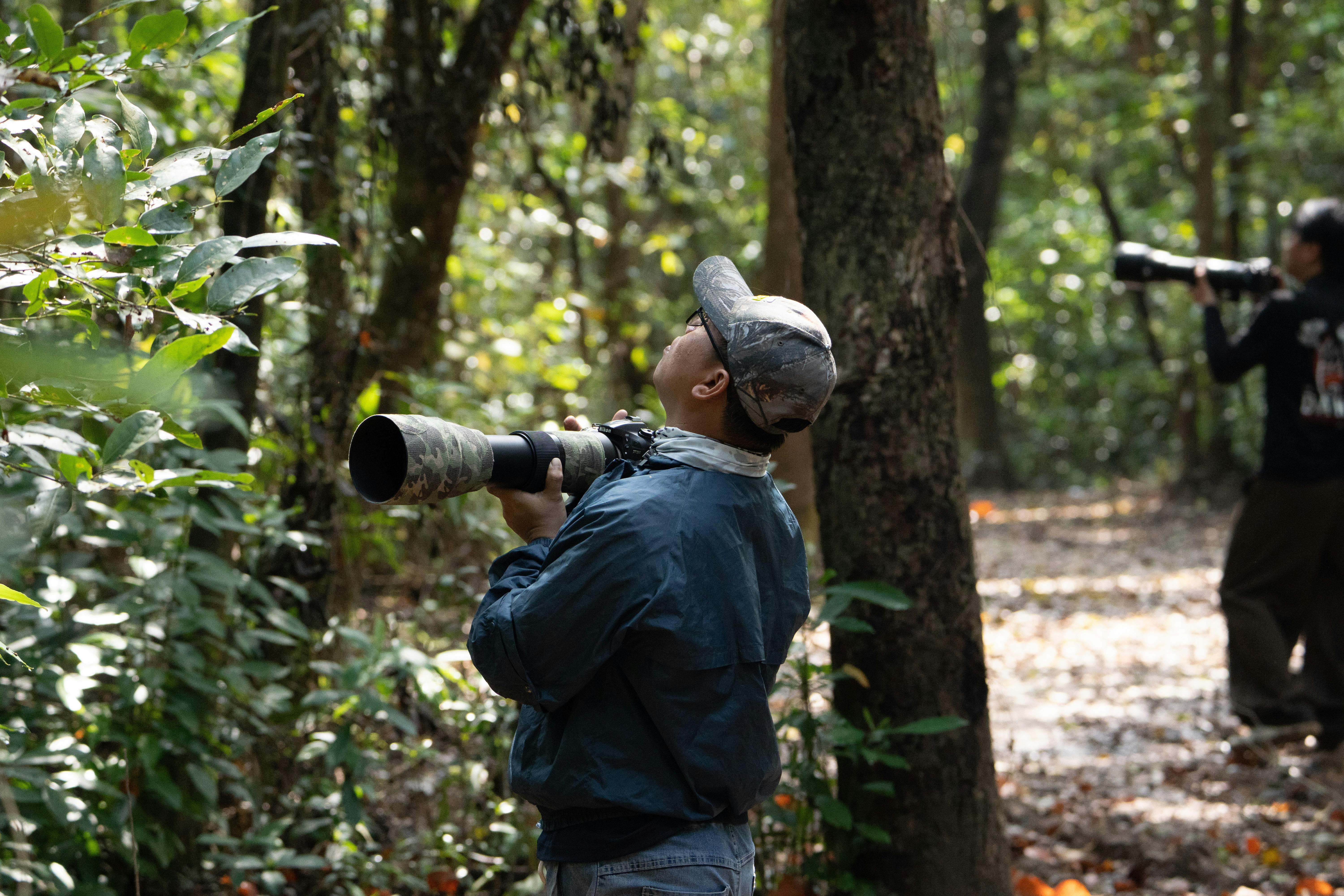
Birding is China's next outdoor obsession. 120M Xiaohongshu views, +70% post growth in 90 days.
You thought birdwatching was for retired uncles with collapsible camping chairs.
The Xiaohongshu hashtag #观鸟 (guan niao, "birdwatching") just crossed 120 million views in the last 90 days. Post count up over 70%. Top creator @空心菜 (kong xin cai, "Hollow Stem") cleared 250,000 engagements on a single bird video.
The Chinese internet calls the trend niao men 鸟门 ("the bird gate," play on Pizzagate-style suffix). Hilton, Volkswagen, and Jinbei (Sony's China camera arm) already have campaigns in market. Outdoor sportswear brands without a soft-adventure narrative are about to lose 18 months of catch-up time.
What changed in 90 days
Chinese outdoor consumption is splitting into 2 distinct phases. The first phase, 2022-2024, was hardcore: UTMB Mont Blanc finisher status, Arc'teryx checkout-counter peer pressure, Salomon trail shoes as flex object. Climbing 7,000-meter peaks, ultra-marathons, ski touring at minus-30. The performance era.
Phase 2, kicking in hard in Q1 2026, is the soft phase. Chinese-source social analysis calls it yu zi ran tong zhen 与自然同振 ("vibrating in sync with nature"). The framework shift: outdoor as urban escape, not extreme challenge. Slow. Mindful. Photographable. Friend-group compatible.
Birding sits at the dead center of this shift. It requires:
1 pair of binoculars (RMB 1,500-8,000)
A camera with telephoto (RMB 4,000-30,000)
Soft outdoor apparel that doesn't scream "I'm hiking K2"
A weekend afternoon at a nearby nature reserve
An Xiaohongshu post about which species you spotted
Bird-spotting in the wetlands outside Shanghai (Chongming Dongtan), the parks of Beijing (Yuanmingyuan, Olympic Forest Park), the Pearl River Delta mudflats of Shenzhen, and the West Lake area in Hangzhou has gone from niche-niche to weekend-weekend in under a year.
The 3 brands that moved first
The brands that already activated against birding are not the outdoor brands you'd expect. They're hospitality, automotive, and camera gear.
Hilton built a "real-life Animal World" campaign tying its mainland China hotel portfolio to nearby bird-watching reserves. Bookings get bundled with reserve guides, gear rental, and a "bird ID checklist" branded as the in-room experience. Stay-and-spot packages.
Volkswagen activated a "Chasing Bird Waves" (zhui zhu niao lang 追逐鸟浪) tour-driving experience. SUV product placement, bird migration route maps, and 3-day weekend road-trip itineraries to hotspot reserves. Auto brand finds the "outdoor with car needed" wedge nobody else owns.
Jinbei (金贝, the Chinese photo lighting and camera accessories brand) dropped a "Seagull Photography Tips" content series targeting amateur bird photographers. Long-tail content that ranks for "how to photograph birds" keyword queries. Direct-response gear sales attached.
Notice who's missing from this list: The North Face, Patagonia, Arc'teryx, Columbia, Salomon, Decathlon. All the obvious outdoor brands. None of them have activated against birding. The space is wide open.
Why this trend is different
Birding maps onto 5 simultaneous Chinese consumer shifts:
1. The escape-from-office bait. Knowledge-worker burnout is at a generational high. Birding offers the cleanest 4-hour escape pattern: drive 90 minutes, walk slowly with binoculars, return Sunday afternoon, post 6 photos. The lowest-effort outdoor format with the highest aesthetic payoff.
2. The "soft luxury" alignment. China's quiet-luxury trend (an jing she chi 安静奢侈) values understated competence over loud display. Birding gear, binocular brands like Leica, Swarovski Optik, Nikon Monarch, all sit in the RMB 5,000-30,000 quiet-flex price tier. Spotting an oriental stork sells better on Xiaohongshu than wearing a logo-front Moncler jacket in 2026.
3. The "old money" aesthetic overlap. Tweed jackets, wide-brim hats (see: Borsalino's China entry this month), waxed cotton field coats, hiking boots that look like loafers. The birding wardrobe is the Ralph Lauren Greater China +88% playbook taken outdoors. Brands like Filson, Barbour, Loro Piana, and Brunello Cucinelli could all extend the British/Italian estate aesthetic into a literal outdoor practice.
4. The friend-group activity slot. China's young urban professionals organize weekend social around shared activity, not shared meals. Brunch alone won't anchor a Sunday plan in 2026. Brunch plus a bird walk does. Group dynamics drive 3-5 friends to gear up together. The unit economics of "everyone in the friend group buys binoculars" are powerful.
5. The Xiaohongshu algorithm reward. Bird photos with species ID captions, location tags, and gear breakdowns get extreme save and share rates. The Xiaohongshu algorithm interprets "save" and "share" as long-tail value signals. Birding content compounds on the algorithm because it's evergreen reference (how to identify, where to spot, what gear).
For the brand, this means: 1 piece of well-crafted birding content can drive 6 months of inbound discovery. The opposite of fashion-runway content (which decays in 48 hours).
The brand-side playbook
If you're a Western outdoor, hospitality, optics, or lifestyle brand reading this, the next 90 days are critical. The category window is still open. Here's how to activate:
For outdoor apparel brands:
Drop a birding-specific capsule. Muted greens, warm browns, navy. No black logos. Quiet fabrics that don't startle birds.
Sponsor 3-5 birding KOLs on Xiaohongshu through summer 2026 with "spotted species" content series.
Build a partnership with one of the major mainland nature reserves (Chongming Dongtan, Yancheng, Poyang Lake) as a season-long brand activation.
For optics and camera brands:
Bundle binoculars + telephoto lens + carrying gear as a "Birding Starter Kit" priced at RMB 5,000-12,000.
Localize content to Chinese species names (oriental stork = dong fang bai guan 东方白鹳, black-faced spoonbill = hei lian pi lu 黑脸琵鹭, etc).
Sponsor regional birding tournaments and weekend bird counts.
For hospitality brands:
Bundle hotel stay with reserve access, equipment rental, and guide service. Hilton already showed the format.
Position your nearest property as the closest comfortable bed to each major reserve.
For lifestyle and tech brands:
A bird-ID AI app (powered by image recognition) sponsored by a phone brand or AI company is the obvious unmet need.
Wearable bird-call recognition. Smart watches with bird-spotting badges.
Camera-equipped drones explicitly approved for bird photography (most reserves ban regular drones).
What you should do this quarter
A 5-point checklist:
Assign one product manager to the soft-adventure trend by Monday. It's a vertical, not a one-off campaign.
Choose your soft-adventure niche. Birding. Foraging. Sea kayaking. Stargazing. Open-water swimming. Each one has the same Xiaohongshu trajectory. Birding is the most mature. Pick one and own it.
Audit your apparel SKU mix for "loud-outdoor vs quiet-outdoor." If your range is 80% bright-color performance and 20% earthy field-aesthetic, flip it for China. The market shifted.
Map your top 5 China DCs to the top 20 mainland nature reserves. Logistics for gear-bundle delivery to second-tier reserve towns is now a real moat.
Book Xiaohongshu KOL contracts before the price spikes. Top birding creators were charging RMB 8,000-25,000 per post in March 2026. By August, with brand interest now obvious, those prices will triple.
The closing read
China outdoor just turned from extreme-aspirational to slow-aspirational in 90 days. The brands that built their China growth on "buy my hardcore trail shoes" are now competing against brands that build on "go spot 12 species with your friends."
The Arc'teryx flagship model still works (Q1 2026 omnichannel comp accelerating). But the next 18 months of category growth in Chinese outdoor are coming from the soft-adventure tier.
Birding is the canary. Your brand strategy is the coal mine. Listen to where the bird went.

