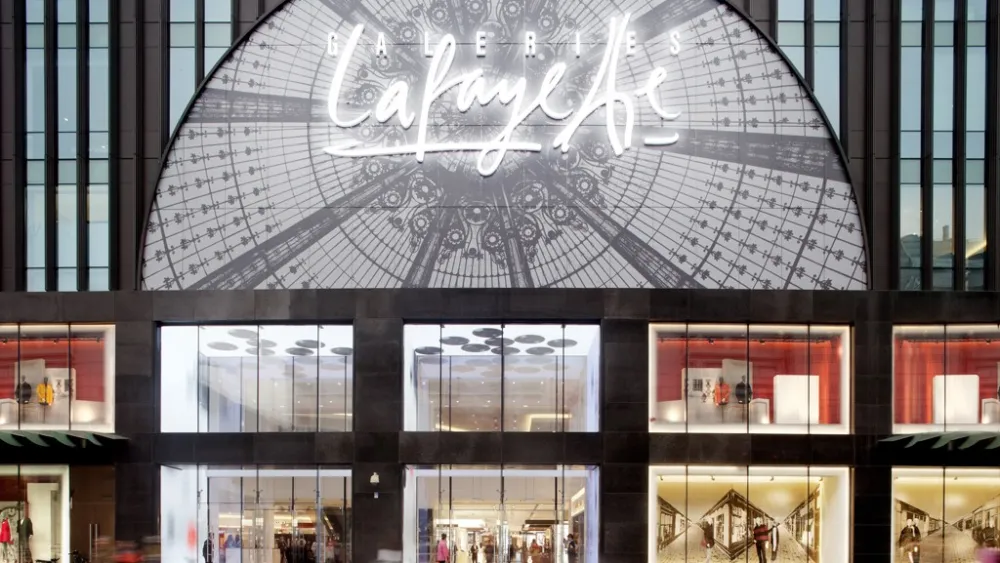
Galeries Lafayette Just Pulled the Plug on Beijing. May 27.
On May 14, Galeries Lafayette announced that its Beijing Xidan flagship closes on May 27.
That's a 12-year-old store, 47,000 square meters across 6 floors, sitting on one of the most iconic department store streets in China. Gone in 13 days.
In 2023, the brand told Yicai it planned to operate 10 China stores by 2025. Today the brand operates 2. Shanghai Lujiazui, Shenzhen Upperhills. That's it.
The math: 10 planned, 2 surviving. 80% short of the target the CEO publicly committed to 30 months ago.
If you're a Western brand owner watching this and thinking it's a department store story, look closer. This is a Western retail format collapse story. And the lesson tucks under it like a bill someone left for you.
The closure timeline
The Beijing Xidan store opened October 2013 as Galeries Lafayette's first China flagship after a failed 1997 attempt on Wangfujing Street that lasted under a year. The 2013 reopening was the brand's big strategic re-entry into China.
The store ran for 12 years.
A condensed timeline of what just happened:
March 2025: Chongqing store closes after 18 months.
April 9, 2026: Deputy CEO Alexandre Liot tells Jing Daily "everything is on the table" for the China business. CEO Arthur Lemoine says the Beijing store was "probably too big."
May 14, 2026: Beijing closure announced. Effective May 27.
What's left: Shanghai L+Mall Lujiazui (25,000 sqm, opened 2019), Shenzhen Upperhills (4,500 sqm, opened 2023). Hopson Group is the JV partner for both.
So in 14 months the Hopson-Galeries Lafayette joint venture lost 60% of its mainland store base. Both closed stores were Hopson-operated.
The official story is a real estate problem ("too big"), a tenant fit problem (Xidan's foot traffic isn't ultra-luxury), and a partner problem (Hopson is itself in trouble as a real estate operator).
The real story sits underneath all 3.
Why French department store retail fails in 2026 China
The Chinese consumer who used to buy at Galeries Lafayette has moved.
She doesn't shop department stores for "curation." Xiaohongshu does the curation for her. She doesn't shop department stores for "discovery." Douyin and Bilibili do the discovery. She doesn't shop department stores for "service." The boutique-format flagships (Hermès Sanlitun, Louis Vuitton Tower, Boucheron Xintiandi) handle the service that wealthy buyers want, with white-glove pickup, dedicated styling rooms, and after-hours private appointments. The mid-tier mall (Taikoo Li, Wanda, MIXC, K11) handles the rest with restaurants and entertainment baked in.
What's left for an aggregator format like Galeries Lafayette? In Paris, the answer is "tourists." 90% of Galeries Lafayette Haussmann's customers are foreign visitors. The tourist economy carries the brand at home.
In Beijing Xidan, there are no tourists. The local consumer doesn't need a French aggregator to find Comme des Garçons, Off-White, or Simone Rocha, all of which I.T used to run as shop-in-shops inside Galeries Lafayette Beijing under the original 2013 JV. Those labels can now be bought direct from their own flagships, Tmall, Xiaohongshu, or grey-market channels.
The Western department store model in China assumes a buyer who doesn't exist anymore.
What the Hopson partnership tells you
The bigger story is the partner.
Galeries Lafayette ended its 2013-era JV with Hong Kong retailer I.T in 2023 and switched to a 50-50 JV with Hopson Group, a Hong Kong-listed mainland real estate developer. Hopson handled the new China stores: Shenzhen (July 2023), Chongqing (September 2023), the Macau plan, and the never-opened 5th-6th-7th-8th-9th-10th locations.
Hopson is a real estate company. China property is in distress. Hopson is itself under significant balance-sheet pressure. The "Galeries Lafayette China" ambition was funded substantially by the partner's ability to bankroll new openings.
So when you read "Galeries Lafayette retreating from China," translate it as: "the Chinese real estate partner can no longer fund the buildout, and the French parent can't either."
This is a pattern. Pandora is shopping a local Chinese operator. Reebok handed China retail to Xinrui Sports. Lanvin Group's Greater China revenue collapsed 18%. Western brands and their Chinese real estate or distribution partners are both running out of money at the same time, in the same market, for the same reason: the Chinese consumer rotated to local brands and to formats the joint venture wasn't built for.
What Galeries Lafayette tried (and where it didn't work)
I'll give the brand credit for trying. The Beijing Xidan store ran:
Designer incubation programs hosting emerging Chinese brands
Themed pop-up retail rotations
Online retail integration with WeChat and Tmall
Café Kitsuné inside Shenzhen Upperhills, building lifestyle adjacency
80+ designer brands in Shenzhen, some debuting in Asia for the first time
None of it moved the needle enough to save Beijing.
The problem wasn't poor execution on tactics. The problem was the format. A 47,000 sqm Western department store in 2026 China is a building looking for a customer who left the address 5 years ago.
What you should take from this
If you operate a Western brand in or near China, the Galeries Lafayette closure should hit your strategy review this week:
Audit your distribution channel risk by partner type. If your China business runs through a Hopson-style real estate JV partner, check that partner's debt position. The next two years will see more partner-driven retail collapses than brand-driven ones. Diversify before you have to.
Map your Chinese customer's actual shopping flow. Where does she discover product (Xiaohongshu, Douyin, friends)? Where does she research it (Bilibili, RED reviews)? Where does she buy it (Tmall, JD, brand flagship, mall boutique)? Where does she get service (boutique flagship or premium mall)? A department store sits in the middle of that flow and doesn't own any step of it. If your retail footprint depends on a customer following the 2013 flow, you have a 2013 footprint.
Cut store size before someone cuts it for you. The CEO of Galeries Lafayette has now publicly said the Beijing store was "too big." 47,000 sqm. Western brands operating 1,500-3,000 sqm flagships in China should ask the same question. The math on rent, staff, and inventory throughput in a market that wants 200-500 sqm boutique experiences is brutal.
Reconsider what your store actually sells. A China store in 2026 needs a job: product education, brand culture, community gathering, exclusive product launches, premium service. A store that exists just to display inventory is a store that loses to Tmall every day.
Watch the survivors. Shanghai Lujiazui and Shenzhen Upperhills are smaller and located in better-curated, less foot-traffic-dependent neighborhoods. If Galeries Lafayette focuses there with a tighter brand mix and stronger community programs, the brand survives China. If those 2 stores follow Beijing within 18 months, the brand is gone from the mainland.
Beijing Xidan opened in 2013 to host a French luxury retail format for a Chinese consumer who was hungry for European curation. That consumer grew up. She still wants European product. She just doesn't need a French building to find it. Watch carefully which Western brand owners adjust to that reality, and which ones spend another decade pretending the 2013 customer is still walking through the door.

