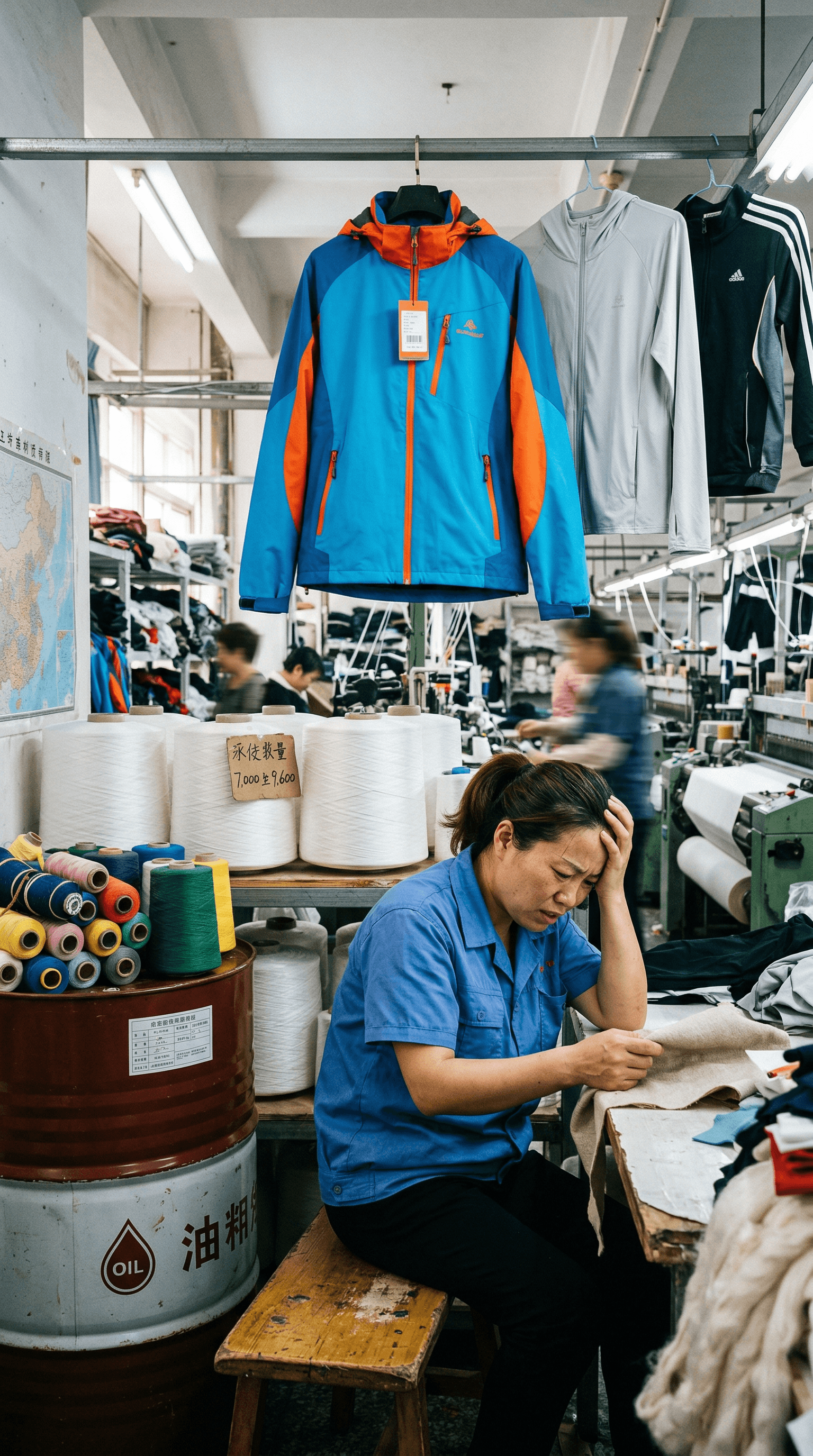
Your Outdoor Jacket Just Got 15% More Expensive. Blame the Oil Price.
7,000 RMB per ton in January. 9,600 RMB per ton by March 10. That's polyester POY, the backbone fiber of almost every outdoor jacket, sportswear piece, and sun-protective garment sold in China.
A 35% price spike in less than two months. One night alone saw a 20% jump... roughly 2,000 RMB per ton vanishing into thin air.
This isn't a blip. It's a supply chain earthquake. And if your brand sells anything made of synthetic fabric in China, you're about to feel it.
What Happened
Brent crude broke through $110 a barrel. The cause doesn't matter for this article. What matters is the chain reaction.
Oil goes up. Petrochemicals go up. PTA and MEG, the raw ingredients for polyester, go up. Polyester fiber goes up. Nylon goes up. Spandex goes up. Even cotton-adjacent materials are getting dragged along for the ride.
Chinese textile manufacturers told 21jingji and Bloomberg that fiber suppliers are now adjusting prices once or even twice a day. Some upstream fabric factories have stopped quoting entirely because they can't guarantee a price for longer than 24 hours.
Let that sink in. Factories that supply the raw materials for your product literally cannot give you a stable price.
CCTV Finance confirmed the numbers: polyester POY went from 7,000 RMB/ton at the end of January to 9,600 RMB/ton by March 10, and was still holding at 9,325 RMB/ton as of March 17. The DWR (durable water repellent) coatings and pressure-sealing strips used in outdoor jackets are also climbing, because their upstream intermediates are oil derivatives too.
This is systemic. Every layer of the supply chain is passing costs upward.
Who Gets Hit Hardest
Not luxury brands. Hermes isn't sweating a polyester price hike. This hits the middle of the market, hard.
Outdoor jackets (chongfengyi, 冲锋衣) are ground zero. Fabric costs make up 60-70% of total production cost for a typical outdoor jacket. A mass-market 500 RMB outdoor jacket just absorbed an extra 40 RMB in raw material costs from polyester alone. For a 1,000+ RMB mid-to-high-end jacket, the increase is 60 to 100 RMB, and that's before you factor in processing and logistics costs that are also climbing.
Sun-protective clothing (fangshaiyi, 防晒衣) is next. These products are almost entirely synthetic and sell at lower price points, meaning the margin squeeze is brutal.
Sportswear and quick-dry clothing round out the hit list. Any brand making performance apparel from chemical fibers is staring at a cost structure that looks very different from what they budgeted three months ago.
The industry consensus, backed by reporting from Sina Finance, 21jingji, and CCTV: if oil prices hold at current levels, fall/winter 2026 outdoor jacket prices will rise 5% to 15%. Mid-market and budget brands get hit the hardest because they can't absorb the margin loss.
Why This Matters for Western Brands in China
Here's where it gets interesting for anyone reading this from outside China.
China is the world's factory for synthetic apparel. Even if your brand doesn't sell directly in China, there's a good chance your products are manufactured there. The cost increase isn't contained within China's borders. It will ripple through global supply chains within 1-2 months, the typical lag for cost transmission through the textile chain.
But for brands that DO sell in China, the picture is more complex:
The outdoor boom is colliding with cost pressure. China's outdoor footwear grew 65% in January-February. Outdoor apparel grew 47%. 20+ international outdoor brands just piled into the market. Everyone was betting on growth. Nobody budgeted for a 35% raw material spike. The brands with the thinnest margins, and the freshest China operations, are the most exposed.
Head-brand insulation is temporary. Multiple functional apparel brands told 21jingji that their supply chain is "currently stable" because they locked in prices before the spike. But that inventory buffer doesn't last forever. One outdoor brand executive said the quiet part out loud: "There are messages about price increases, but actual contracts haven't seen real price increases yet." The word "yet" is doing a lot of heavy lifting in that sentence.
Small and mid-tier brands will be squeezed out. Big brands like Anta, Arc'teryx, and Salomon have the scale and pre-existing contracts to absorb short-term cost spikes. Smaller brands, especially the wave of international entrants that just opened their first China stores, don't have that luxury. If you entered China with tight margins and a growth-at-all-costs mindset, this oil shock just changed your math.
Your Action Plan
1. Audit your supply chain exposure RIGHT NOW. If your product uses polyester, nylon, spandex, or any oil-derived synthetic fiber, get updated pricing from your Chinese suppliers this week. Not next month. This week. The situation is changing daily.
2. Don't panic-raise prices on Chinese consumers. Chinese consumers are rational and price-sensitive. A blanket 15% price hike will push them to domestic alternatives. If you must adjust pricing, do it surgically on specific SKUs and communicate the value story.
3. Negotiate longer-term contracts if you can. If your supplier relationships are strong enough, lock in pricing for 6-12 months. You'll pay more than January levels but less than the current panic pricing. The brands that move first will get better terms than the brands that wait.
4. Watch the fast-fashion response. Brands like UR and Shein that operate on razor-thin margins and massive volumes will be the first to adjust. Their pricing moves will set the floor for what Chinese consumers expect to pay. If fast fashion absorbs the cost, premium brands that raise prices will look greedy.
5. Explore material alternatives. Several Chinese manufacturers are already investing in non-petroleum-dependent fibers, including recycled polyester, PLA (polylactic acid), and bio-based synthetics. JD Fashion literally showcased proprietary eco-materials at Fashion Week last week. This crisis might accelerate the shift away from oil-dependent textiles faster than anyone expected.
The outdoor boom in China is real. The athleisure wave is real. But oil at $110 a barrel just reminded everyone that fashion has a supply chain, and supply chains don't care about your growth story.
The brands that planned for disruption will be fine. The brands that didn't just got their first lesson.

